
Flutter Entertainment plc is the parent company behind betting and gaming brands including FanDuel, Paddy Power, Betfair, PokerStars and Sky Betting & Gaming. Its business spans online sports betting and iGaming. Major deals gave it different routes to growth: shared operating functions through Paddy Power and Betfair, an American sports audience through FanDuel, and additional products through The Stars Group.
The cost of assembling that portfolio extended beyond buying shares. Flutter’s records show integration spending, changes to commercial agreements and continuing work on technology and common functions. Those commitments run through the group’s development from its Irish business origins to its expansion in the United States.

Flutter Share Price: NYSE, USD and the Former LSE Listing
Flutter Entertainment share price: dated market snapshot
US$78.98 per share · NYSE: FLUT · USD Regular-session close: 20 October 2026, 4:00 pm EDT. Market data checked on 21 October 2026. This is a recorded closing price; prices in other sessions may differ.
Editorial concept, research direction and final approval by Lucky BetMastermind. ChatGPT by OpenAI assisted with drafting, structure and editorial refinement.
Contents: Origins · Paddy Power and Betfair · FanDuel · The Stars Group · Local expansion · Brands · Numbers and leadership · Costs and limits
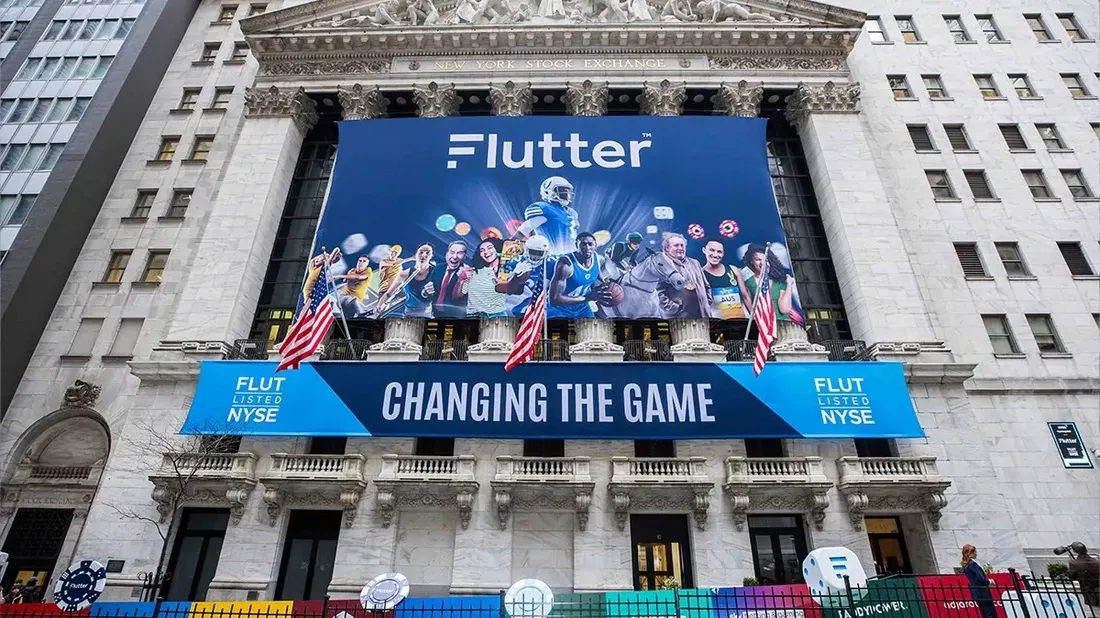
Flutter Entertainment stock began trading on the New York Stock Exchange on 29 January 2024. Its primary listing moved to New York on 31 May 2024, as recorded in the annual report, PDF p21. A further, separate change came on 3 August 2026, when the company confirmed cancellation of its London listing and admission to trading. Flutter said its ordinary shares were then listed solely on the NYSE.
Historical London references use FLTR and may quote prices in GBX, or pence sterling. Those records need their own dates and currency labels when compared with NYSE prices in US dollars. For a later quote, check the current session and timestamp before updating the page.

Where Flutter’s History Begins
Several dates appear in accounts of Flutter’s founding because they describe different stages of its development. The 2025 annual report, PDF p21, traces the legal company to 8 April 1958, when Corcoran’s Management Limited was incorporated in Ireland under company number 16956. That establishes legal continuity; the present collection of international brands developed much later.
The Paddy Power business emerged in 1988 through the combination of three independent bookmakers. Flutter’s tribute to David Power identifies David Power, Stewart Kenny and John Corcoran as its founders. Their combined betting shops supplied the business origins behind the familiar consumer name.
The group took another form when Paddy Power and Betfair completed their merger on 2 February 2016, becoming Paddy Power Betfair plc. On 28 May 2019, the company changed its name to Flutter Entertainment plc. The new name therefore belongs partway through the acquisition story: the FanDuel agreement had already been announced in 2018, while The Stars Group combination still lay ahead.
The dates mark distinct milestones: legal incorporation, Paddy Power’s formation, the Betfair merger and the adoption of the Flutter name.
The Major Deals at a Glance
| Event | Documented stage | What it brought into the group |
|---|---|---|
| Paddy Power and Betfair, 2 February 2016 | Merger completed | Two consumer businesses with scope for shared operating functions |
| Betfair US and FanDuel, 23 May 2018 | Agreement announced; control acquired during 2018 | FanDuel’s daily fantasy sports audience, brand and team |
| The Stars Group, 5 May 2020 | Combination completed | A broader portfolio including PokerStars and Sky Betting & Gaming |
| Fastball’s FanDuel stake, 3 December 2020 | Conditional agreement announced | A proposed increase from 57.8% to 95% in the existing US business |
| Sisal, August 2022 | Acquisition recorded in the annual report | Additional Italian betting, gaming and lottery operations |
| Snai, 30 April 2025 | Acquired business consolidated | Further Italian operations across online and retail channels |
| Boyd’s FanDuel interest, 31 July 2025 | Buyout completed | Reported 100% ownership, subject to the Fox Option described below |
Sources: 2016 completion, PDF p1; 2018 agreement, PDF p1; the completion notices and annual-report sections discussed below.

What the Paddy Power and Betfair Merger Changed
The completion announcement, PDF p1, fixes the decisive date at 2 February 2016. This was an all-share merger. The former Paddy Power and Betfair shareholders received 52% and 48% respectively, on the fully diluted basis described in the transaction accounting. Those percentages describe the merger’s structure at the time.
The combination put the two businesses inside a group that could share operating functions while maintaining distinct consumer propositions. In its 2016 results, PDF pp. 5-6, management described common digital marketing, risk and trading, and customer operations. Technology integration was still continuing. Functions could serve both businesses while customers continued to encounter separate brands.
The integration update on PDF p4 reported £35 million of synergy benefits in 2016, alongside £66 million of one-off implementation costs, and stated that the full annual benefit would be £65 million from the 2017 financial year. The first figure concerns a year’s reported benefits, the second implementation expenditure, and the third a stated annual benefit. They measure different parts of the integration and cannot be combined into a simple return-on-investment calculation.
The transaction accounting, PDF pp. 37-38, recorded £4,313.7 million of consideration for Betfair, comprising issued shares and replacement options. This was the accounting consideration for the acquired business.

How FanDuel Changed the Geography of the Group
On 23 May 2018, Paddy Power Betfair announced an agreement to combine Betfair US with FanDuel, PDF p1. FanDuel was a US daily fantasy sports operator. It brought an existing sports-focused customer base, an established brand and a team to a group already operating in the country. Management presented those assets as a way to pursue the prospective US sports-betting market and strengthen discussions with market-access providers.
Paddy Power Betfair would contribute its US assets and US$158 million in cash for an initial 61% interest upon completion. The agreement provided for operational control, including the right to appoint the CEO and a majority of the board. Flutter’s later financial statements, PDF p63, place the initial acquisition of control in 2018. The May release itself records the agreement stage.
Later purchases increased Flutter’s interest in FanDuel. They changed its economic ownership after it had already obtained control.
On 3 December 2020, Flutter announced a conditional agreement, PDF p1, to acquire Fastball’s 37.2% stake for US$4.175 billion. It described an increase from 57.8% to 95%, subject to shareholder approval. These percentages belong to that later transaction; the initial 61% had changed following a subsequent market-access deal with Boyd, as the release explains on PDF p3. The December announcement establishes the terms of the agreement, rather than its precise completion date.
On 31 July 2025, Flutter confirmed completion of the buyout of Boyd Gaming’s 5% interest. Its 2025 annual report, PDF p75, described the resulting 100% ownership as subject to the Fox Option. At 31 December 2025, that outstanding option concerned an 18.6% interest; it represented a right to acquire an equity interest, with exercise requiring Fox to be licensed (PDF p152).
Boyd reported US$1.758 billion in cash proceeds. Flutter’s report separates that total into US$1.553 billion for the 5% equity interest and US$205 million for terminating certain existing market-access and retail agreements. The combined payment consequently covered both shares and changes to commercial arrangements.
The Boyd partnership was also extended to 2038, with market-access savings effective from 1 July 2025. Reaching the reported ownership milestone still left a continuing commercial relationship with Boyd. That relationship concerned the terms on which the business operated in its markets, alongside the question of who owned its equity.

What The Stars Group Added
The combination with The Stars Group completed on 5 May 2020, according to the completion notice filed with the SEC. The 2019 announcement belongs to the agreement stage; May 2020 marks the completed combination.
The Stars Group brought PokerStars and Sky Betting & Gaming into Flutter’s portfolio. The group’s financial statements, PDF p63, record that route into the business. PokerStars added a business built around poker and other gaming products. Sky Betting & Gaming added a UK betting and gaming business alongside the group’s existing UK and Irish brands.
The transaction broadened the product mix and added established consumer businesses in markets where Flutter already operated. This was a different addition from FanDuel’s US audience: the group acquired more ways to serve betting and gaming customers, including international poker players. Its later FY2025 geographic reporting, PDF p24, places Sky in the UK and Ireland business and PokerStars across several markets, including Italy. Those positions show how the acquired brands became part of the wider portfolio.

Expansion Through Local Businesses
The 2025 annual report, PDF p42, records the acquisition of Sisal in August 2022. Sisal added an Italian business spanning betting, gaming and lottery operations. In 2025, Snai added further Italian operations, with the acquired business included from 30 April.
The report also dates the acquisition of a 56% interest in NSX, associated with Betnacional in Brazil, to 14 May 2025 (PDF p135). These entries show a further route to expansion: acquiring businesses already organised around particular national markets. In its strategy discussion, Flutter describes an approach built around local brands, supported after acquisition by group capabilities.
The NSX transaction also included a contribution from Flutter’s existing Betfair Brazil business, as the acquisition note records. The Brazilian expansion therefore combined operations already inside the group with the acquired local business. Flutter’s 56% interest gave it majority ownership, with the other shareholders retaining the remaining 44%.
Snai’s acquisition accounting, PDF p133, identifies trademarks, online customer relationships, a point-of-sale network, licences and technology among the acquired assets. The business combined online operations with a physical distribution network. Keeping that detail in view explains what was acquired more clearly than describing the deal only as an increase in market presence.
Snai and NSX contributed to the group’s consolidated results for only part of 2025, from their respective acquisition dates. Annual revenue growth therefore reflects a changed set of businesses as well as developments within existing operations. The inclusion dates help distinguish an acquisition’s immediate effect on reported scale from growth measured over a full year on a comparable basis.

Why the Group Keeps Different Brands
The following selection connects the main consumer brands to the transactions discussed here; market and product descriptions reflect Flutter’s FY2025 reporting, PDF pp. 23-24.

 Sports betting and iGamingUnited States
 Betting and gamingUK and Ireland
 Exchange, betting and gamingSeveral markets
 Poker and other gamingSeveral markets
 Betting and gaming brandsUK and Ireland
 Online bingoUK and Ireland business
Official brand marks supplied through Flutter media download packs. The cards show product and market context, not a legal ownership chart.
| Consumer brand | Market or product context | Route into the group |
|---|---|---|
| Paddy Power | UK and Ireland betting and gaming | The original business in the 2016 combination |
| Betfair | Betting, gaming and exchange products across several markets | Merger completed in February 2016 |
| FanDuel | US betting and gaming | Control acquired in 2018; subsequent stake purchases |
| PokerStars | Poker and other gaming across several markets | The Stars Group combination, May 2020 |
| Sky Betting & Gaming | UK and Ireland betting and gaming | The Stars Group combination, May 2020 |
| Sisal | Italian betting, gaming and lottery operations, with other lottery businesses | Acquisition in August 2022 |
| Snai | Italian betting and gaming across online and retail channels | Acquired and consolidated from April 2025 |
| Betnacional | Brazilian betting business | NSX acquisition in May 2025 |
Sportsbet and tombola also appear in the FY2025 portfolio. Sportsbet serves the Australian sports-betting market; tombola is an online bingo brand within the UK and Ireland business.
Flutter calls the shared benefits of product, technology, expertise and scale the “Flutter Edge” (annual report, PDF pp. 71-72). Under management’s model, brands retain their local customer relationships while drawing on resources from the wider group. The 2016 record shows an early example: separate consumer propositions supported by common functions.
A consumer brand, a licensed operator and the public parent describe different levels of the business. This table maps commercial history. Establishing a particular website’s operator, permissions or direct ownership chain requires the documents for that service and jurisdiction.

Flutter in Numbers, Ownership and Leadership
For a consistent financial snapshot, Flutter’s 2025 annual report, PDF p78, supplies the following consolidated results:
| Metric | Year ended 31 December 2025 |
|---|---|
| Group revenue | US$16,383 million |
| Operating profit | US$36 million |
| Net loss | US$407 million |
Basis: Flutter group, US GAAP, US dollars; financial summary on PDF p78 and audited consolidated statement on PDF p104.
Revenue records income from the group’s activities before the expenses used to calculate operating profit. Net loss reflects further items, including financing costs and tax. In FY2025, Flutter’s large revenue total consequently coexisted with a small operating profit and an overall loss. All three figures concern the consolidated group on the stated US GAAP basis; the parent company’s separate accounts cover a different reporting entity.
Flutter is owned by its shareholders as a publicly traded company. The Paddy Power founders explain its business origins, while the 52%/48% split describes the 2016 merger. A present account of major holders would require shareholder filings with compatible reporting dates and definitions of ownership.
As checked on 21 October 2026, Flutter’s executive-committee page identifies Dan Taylor as CEO. The company announced on 5 August 2026 that Taylor would succeed Peter Jackson on 1 October 2026. Its operational headquarters are in New York, while its registered office is in Dublin. Those two locations reflect different corporate functions and explain apparently conflicting answers to a simple headquarters query.

The Costs and Limits of Getting Bigger
Flutter recorded US$247 million of restructuring and integration costs across the group in FY2025. The annual report, PDF p88, note 2, associates these costs with several restructuring programmes, acquisition integration and other strategic initiatives. Activities included consolidating technology and back-office functions, relocating certain operations, redesigning processes and planning a new enterprise resource planning system. The costs mainly comprised severance, advisory fees and temporary staffing. The report expected the programmes to run until 2027.
This puts continuing operational work alongside the headline acquisition dates. The US$247 million covers several group initiatives rather than the cost of integrating one acquired business. It is also a separate category from transaction fees and associated costs, which included the Boyd market-access payment. Keeping those categories distinct prevents a commercial-agreement payment from being counted again as restructuring expenditure.
The report’s risk factors, PDF p42, identify possible difficulties bringing together systems, controls and business cultures, alongside demands on management and exposure to unfamiliar markets. Its discussion on PDF p55 also describes legal and administrative costs from differing US state regimes and risks arising from tax changes. These are management’s disclosed risks, with consequences that depend on the business and market concerned.
The acquisitions gave Flutter product breadth, local distribution, customer relationships and increasing control over FanDuel. Turning those assets into sustained returns still requires operating them effectively after completion. That is the continuing task revealed by the spending programmes: the transaction adds capabilities, and the years that follow determine what the group can make of them.

How We Checked This History
This account uses Flutter’s annual reports, contemporary transaction announcements, SEC-filed completion notices and Boyd’s statement of sale proceeds. Events retain their documented stage; financial results retain their period, currency and accounting basis. Document references to longer PDFs identify the relevant pages. Management’s explanations of strategy are attributed, and the connections drawn between transactions and capabilities are editorial interpretation.
Listing and leadership sources were checked on 21 October 2026. The price card records the 20 October regular-session close, with its source and timestamp.