
Flutter · Capital allocation
Flutter’s share slide tests its US$500m savings plan
Flutter’s shares closed at US$67.30 on 24 November, extending pressure since its quarterly update. The next test for its savings plan is how much cash remains after investment, restructuring and debt requirements, with FanDuel Predicts still at an early revenue stage.
Contents


Flutter Entertainment closed at US$67.30 on the New York Stock Exchange on 24 November, down 0.18% on the day. The shares were 17.7% below their US$81.79 closing price on 4 November, when the owner of FanDuel, Paddy Power, Betfair and Sky Bet presented its quarterly results and a new savings target.
The latest completed session extends the pressure on a business trying to fund growth while reducing debt. Chief executive Dan Taylor’s response includes US$500 million of additional gross operating cost and capital expenditure savings by 2029. The question for shareholders is how much of that benefit will ultimately remain as cash after implementation and investment.
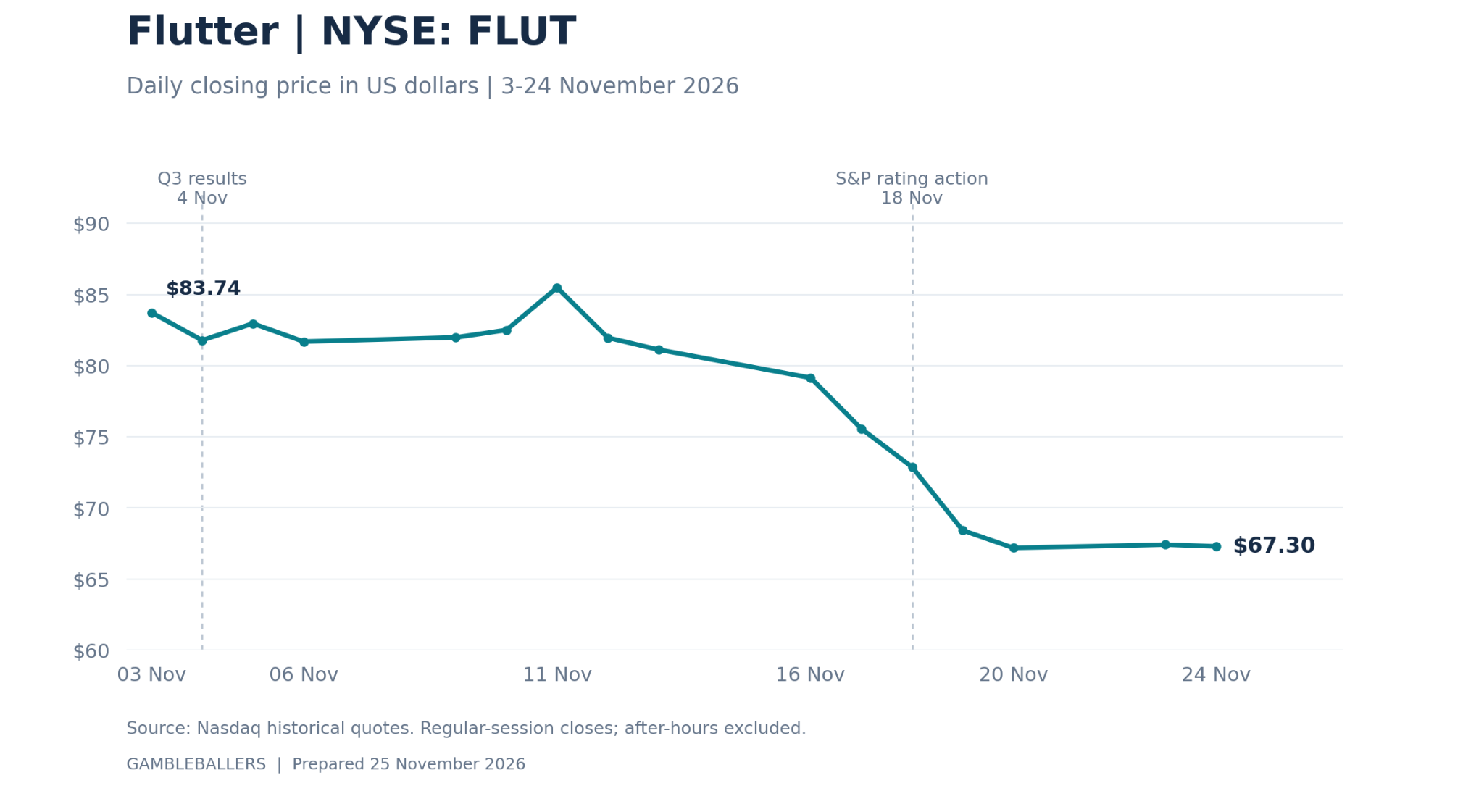
Daily regular-session closes, NYSE: FLUT, US dollars. Source: Nasdaq historical quotes. Event markers identify dates; they do not establish the cause of each price movement.
Buybacks and the credit rating frame the funding choices
Our earlier analysis of Flutter’s paused buybacks and savings programme examined the change announced on 4 November. The group prioritised investment in its businesses and debt reduction, suspending share repurchases for the foreseeable future.
The balance-sheet context remains demanding. At 30 September, Flutter reported net debt of US$10.656 billion and leverage of 4.6 times on its own measure, compared with 3.7 times at the end of 2025. Its medium-term target range is 2.0 to 2.5 times.
S&P Global Ratings cut Flutter’s credit rating from BB+ to BB on 18 November, with a stable outlook, according to SBC News and Cbonds. That earlier action adds a credit perspective to the subsequent equity-market pressure. Credit ratings assess repayment risk; share prices also reflect expectations about the future returns available to owners.
Flutter has taken action on funding. Its November update announced refinancing that extended its revolving credit facility and Term Loan A maturities to May 2032. Extending maturities provides time and flexibility. Reducing leverage still requires a combination of earnings delivery, cash retention and debt management.
Revenue, operating earnings and cash show different pressures
The third-quarter figures illustrate the challenge of converting a large business into greater financial capacity.
Group results: Q3 2026 and Q3 2025
| Group measure | Q3 2026 | Q3 2025 |
|---|---|---|
| Revenue | US$3.874bn | US$3.794bn |
| Adjusted EBITDA | US$360m | US$478m |
| Net cash provided by operating activities | US$211m | US$209m |
Scroll the table horizontally to see every column.
Revenue rose 2%, while adjusted EBITDA fell 25%. Operating cash increased slightly, with Flutter saying a favourable working-capital movement helped offset the weaker performance. That distinction matters: collection and payment timing can support one quarter’s cash figure without demonstrating a lasting improvement in underlying profitability.
The reported group net loss of US$1.148 billion also included a US$873 million non-cash impairment relating to Brazil. That charge reflects a reassessment of asset values rather than an equivalent cash payment during the quarter. It remains relevant to the history of capital committed to the business, while the operating cash statement answers a different question.
Our assessment is that the savings programme should be judged across these measures. A rising operating cash figure would be more persuasive if supported by repeatable earnings improvements. The amount available for debt reduction also has to accommodate capital expenditure and other financing needs.
FanDuel Predicts creates another claim on the budget
Prediction markets show why reducing costs and spending on growth are happening together. Flutter said FanDuel Predicts had 66,000 average monthly players and US$119 million of volume in the third quarter, while its revenue was not material.
Those measures describe different stages of development. Player activity and transaction volume can establish that a product is being used. The eventual financial result depends on revenue earned, the cost of acquiring and serving those customers, and how often they return. The US$119 million volume figure is therefore not a revenue contribution of the same size.
Flutter expects investment in prediction markets to continue in 2027 at similar or higher levels. Management also says increased marketing spending by prediction-market operators is beginning to affect its media costs, even while it sees limited impact on the betting activity of its existing customer base.
In our view, this creates a demanding allocation problem. Flutter is funding a developing product while protecting the competitiveness of an established sportsbook. It needs evidence that the additional spending can build durable customer relationships and, over time, an attractive economic return.
The opportunity may justify investment. The relevant test is the progression from engagement to revenue and contribution after costs, with the regulatory uncertainty acknowledged by the company also influencing how much capital it commits.
The savings target covers costs and investment
The US$500 million target is additional to existing international transformation and UK gaming-tax mitigation programmes. Taylor’s plan includes removing organisational layers and duplication, simplifying technology and using AI.
Its wording matters. Operating cost savings can improve earnings, subject to implementation costs and reinvestment. Capital expenditure savings reduce investment requirements and have a different immediate relationship with EBITDA. Combining them in one gross target does not make the entire amount an automatic increase in profit or cash available to shareholders.
The commercial case for shared systems is sensible. A large group can benefit when several brands use common infrastructure and solve recurring internal problems once. Delivery requires choices about which work can be shared, which capabilities customers value and where local expertise remains necessary.
The danger for the financial plan is that savings elsewhere are absorbed by higher competition costs, taxes or additional product investment. Some reinvestment may be attractive and deliberate. Management needs to show both the savings achieved and where the released resources go.
Our view: show how savings become retained cash
The share-price decline reinforces the need for evidence of execution. It cannot, by itself, identify the weight investors assign to every concern or establish that the programme will fail. The plan is a multi-year undertaking, and the current price also reflects expectations beyond the measures announced in November.
We would look for a clear account of gross savings delivered, implementation costs, reinvestment and the net effect on cash generation. Alongside that, progress at FanDuel Predicts should be visible through revenue and contribution as well as activity. Debt reduction should then show whether stronger operations are translating into a more flexible balance sheet.
Flutter has the scale and brands to make shared investment valuable. The next phase needs to demonstrate that those advantages allow it to compete effectively while retaining more of the cash it generates. That is the evidence most capable of turning a savings target into a credible funding plan.