
Gamble Ballers · News analysis · Italy
Italy’s Gambling Tax Proposals Would Shift Costs Towards Online
Coalition MPs have proposed relief for gaming machines and additional taxes on online games. Their funding plans differ, and operators with both businesses could face costs as well as savings.
In this article
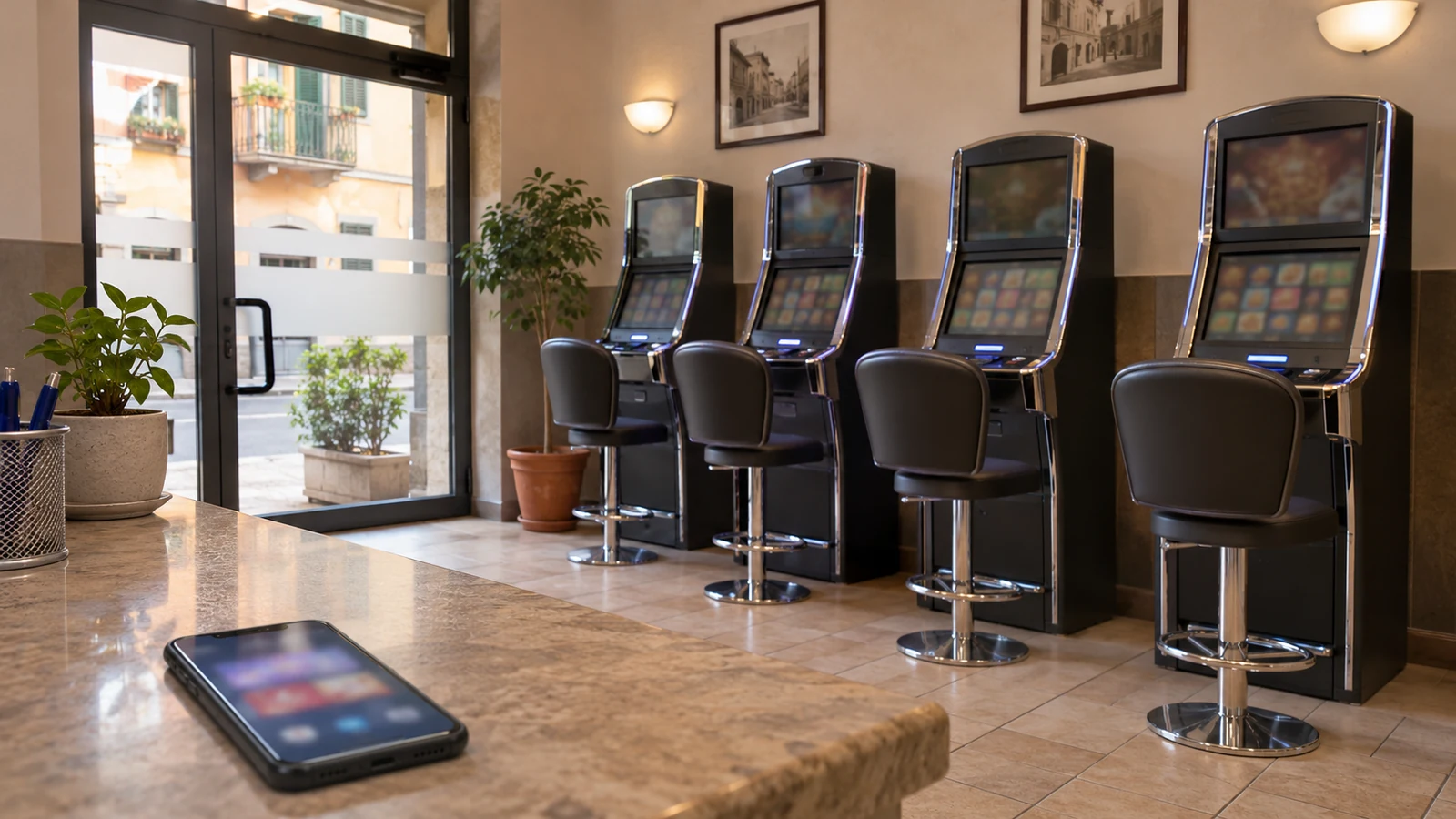
Members of Italy’s governing coalition have proposed changes to the 2027 budget that would ease costs for gaming machines and seek more revenue from online gambling. The amendments reported this week come from Lega’s Andrea de Bertoldi and Forza Italia’s Chiara Tenerini, among others. They have different purposes and funding arrangements, with parliamentary scrutiny still ahead.
For us, the most interesting question is how that redistribution would work inside a group operating in both channels. A company could receive relief on its machines while paying more through its online business. Calling the proposals support for retail tells only part of the story.
The government’s draft explains the pushback
Article 23 of the government’s budget bill would set the PREU machine levy at 25% of stakes for AWP slot machines and 9.6% for video lottery terminals, or VLTs, from 1 January 2027. It also proposes a reduced 20% rate for AWP machines programmed to return at least 70% of stakes in prizes. These are provisions in the draft under consideration.
The same bill would extend relevant retail concessions to the end of 2029 while a broader reorganisation of the physical network is pending. That links the tax argument to a longer-running issue: how the state maintains its licensed retail system while determining its future rules and concession costs.
Several proposals, with different sources of funding
Italian Gaming News reproduces de Bertoldi’s proposed postponement of the PREU increase to January 2030, alongside a reduction in the three-year VLT extension charge from €7,500 to €6,000 for qualifying rights. Its published texts also include a lower payout threshold for access to the reduced AWP levy: 69% instead of 70%.
The threshold proposal would use higher taxes on selected remote games from January 2027 as funding, leaving the products and rates to a later decree from Italy’s customs and monopolies agency, ADM. Another proposal would cut the reduced AWP rate from 20% to 19%, using a scratchcard concession tender as a funding route. These are distinct changes; they should not be treated as one settled package.
Tenerini’s proposal has a different destination for the money. As PressGiochi reports, it would add five percentage points to the tax on the category described as remote skill games from January 2028. The estimated €150 million a year would help finance relief for companies retaining and reinvesting profits. That is a proposal and a revenue estimate, rather than an enacted increase across every online gambling product.
Tax bases matter as much as the headline rates
The Chamber of Deputies’ gambling briefing distinguishes the bases clearly. PREU on AWP and VLT machines is calculated on stakes, whereas the listed taxes on remote skill games, online card games and casino games apply to stakes less prizes returned to players. Comparing the percentages alone cannot establish which product carries the heavier economic burden.
For illustration, one additional percentage point on €100 staked means €1. On €10 remaining after prizes, it means €0.10. These are hypothetical bases, not an estimate for an Italian operator. They show why a transfer of tax burden needs the affected products, tax bases and rates attached before anyone calculates its effect.
Lottomatica shows why the two sides overlap
Our earlier report on Lottomatica’s online growth examined the group’s differing channel performance. Its own nine-month results, published on 3 November, offer a useful starting point here. Lottomatica reports Online, Sports Franchise and Gaming Franchise businesses; the latter includes gaming halls and AWP and VLT concession activities.
| Lottomatica segment | Change in bets, 9M 2026 against 9M 2025 |
|---|---|
| Online | +12% |
| Sports Franchise: retail betting | +11% |
| Gaming Franchise: halls and machines | −2% |
Those are company-reported betting volumes, not revenue changes or a measure of the whole Italian market. They also show why retail should not be treated as a single business moving in one direction.
In our assessment, a group’s eventual benefit would depend on its eligible machines, online product mix, concession payments and commercial contracts. A saving in one segment cannot simply be set against a headline tax increase elsewhere. Calculating the net effect would require the final rules and the actual taxable activity. Even groups with both businesses could therefore reach different outcomes.
The distinction extends beyond large groups. A concession holder, a venue sharing gaming proceeds and a machine manufacturer can have different interests. Lower tax could support a network without passing through equally to every participant. Manufacturers would also depend on whether the changes encourage replacement orders, while venues would need to examine their contractual share of any benefit.
Our view: judge the full cost of the redistribution
Supporting a viable licensed retail network can be a reasonable policy objective. We would judge these proposals by how clearly they identify the beneficiary, the payer and the lasting effect on competition. An online-only operator could face an additional bill without the machine relief available to an integrated rival. That difference deserves an explicit policy justification.
Players’ interests also need a separate assessment. Reducing the payout threshold for a tax concession would broaden eligibility for lower-return machine settings. It would not require every machine to adopt that setting, but neither should the fiscal benefit be presented as an improvement in player returns. Tax relief for an operator and value for a customer are different questions.
Funding through a concession tender also needs to be assessed over its full term. Payments for a fixed-duration right and recurring tax receipts have different timing and risks. Our preference would be a transparent comparison of the revenues forgone, the replacement funding and the assumptions about demand, rather than treating an expected tender price as money already secured.
The parliamentary timetable summarised by Emilia-Romagna’s Rome office schedules admissibility decisions for 23 November and the deadline for parties’ priority amendments for 26 November. These are procedural stages ahead of the final budget outcome. For us, the test is whether the surviving proposals produce a coherent system that operators can plan around, with the costs to each channel and its customers made clear.
Sources
Chamber of Deputies, budget bill C. 3174-bis: committee stage and linked government text, Articles 23 and 26, on proposed machine levies and concession extensions.
Chamber of Deputies, gambling briefing: the tax bases for AWP, VLT and the listed online games.
Italian Gaming News, 18 November 2026: reproduced de Bertoldi proposals and supporting explanations on PREU, VLT rights and alternative funding.
PressGiochi, 19 November 2026: Tenerini’s proposed five-percentage-point increase, January 2028 start and forecast contribution to reinvestment tax relief.
Lottomatica, 3 November 2026, nine-month results: bets by operating segment for the nine months ended 30 September.
Lottomatica directors’ merger report, section 1.2.1.1: definitions of the Online, Sports Franchise and Gaming Franchise businesses.
Emilia-Romagna, Rome office parliamentary update, 17 November 2026: amendment deadline, admissibility timetable and priority selection.
iGB, 20 November 2026: reporting on the coalition parties’ amendments and the shift in the gambling tax debate.