
Gamble Ballers · News analysis · UK regulation
UK Rejects Gambling Ad Ban as Ministers Seek Wider Online Powers
The government has rejected a comprehensive advertising ban while backing a legislative fix for online powers. Our analysis examines the consequences for operators, platforms and affiliate marketing.
In this article
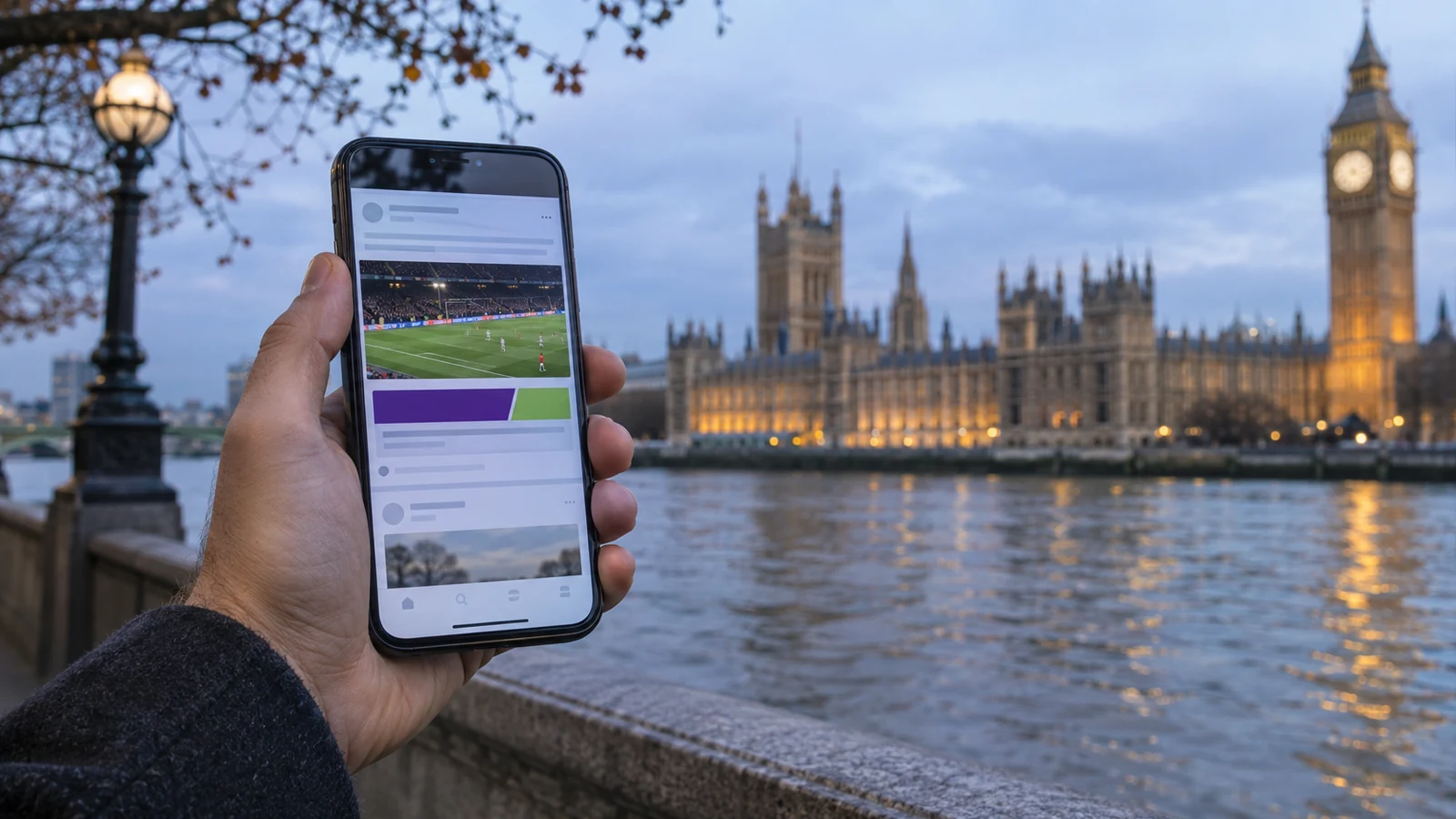
The UK government has rejected a comprehensive ban on gambling advertising in its response to the House of Lords Liaison Committee, published on 19 November. It nevertheless agrees that Parliament should remove a restriction on ministers’ powers over online gambling advertising. The response provides no timetable for that legislation.
Ministers argue that a broad ban would poorly target vulnerable groups and could make licensed businesses harder to distinguish from illegal operators. That reasoning remains a position to evaluate against evidence.
How the debate reached this point
The committee’s report, published on 17 September, had recommended a comprehensive ban as the strongest long-term response to advertising-related gambling harm. It warned that partial restrictions could shift promotion into other channels without reducing its overall volume. The Lords also recognised that a ban would require a transition for affected businesses and sectors. The proposal would have changed whether the industry could advertise at all.
That history matters because an ad can disappear from one visible setting while the same audience encounters promotion elsewhere. In our view, the useful test of a targeted policy is whether it reduces harmful exposure across channels. Counting changes to one format gives only part of that picture.
Why the online power matters
The September report explained the legal obstacle. Section 328 of the Gambling Act 2005 gives the Secretary of State powers to make advertising regulations. The Lords explained that section 333(6) constrains those powers where the online service carrying the advertisement is established in the European Economic Area. This concerns the reach of a particular rule-making power, helping explain the call to amend the underlying legislation.
The response links action to a suitable bill and parliamentary time. Any amendment to the law giving ministers those powers, and any later advertising restrictions, would need scrutiny of their actual wording and scope.
For commercial planning, that leaves uncertainty about future requirements. An operator can retain access to a marketing channel while facing changes to the conditions under which it may use it. Equally, a commitment to seek wider powers offers no basis for claiming that a new online ban has already begun.
Existing rules already reach social media
The Committee of Advertising Practice’s CAP Code requires socially responsible gambling marketing and restricts content with strong appeal to under-18s. Casino and sportsbook ads must not be directed at under-18s through their choice of media or context. CAP’s guidance traces the stronger appeal test to October 2022 and stresses the limits of relying on unverified audience age declarations.
An Advertising Standards Authority (ASA) ruling published on 27 May 2026 illustrates the consequences. The regulator upheld a complaint about two Oddschecker Instagram posts featuring high-profile footballers. Oddschecker considered the posts primarily editorial. The ASA found that they promoted betting through its comparison service and therefore fell within the advertising code’s scope.
The account had an 18-plus setting, but the ASA did not consider its controls sufficient to effectively exclude children. Applying the gambling principles to a service that encouraged betting, it found a breach of the general social-responsibility rule, CAP 1.3. The ruling required the ads to stop appearing in the form complained of.
For us, the practical lesson is the relationship between content and audience evidence. A platform setting needs to support the choice of creative material in the circumstances of the campaign. Where a post promotes betting services, an editorial tone alone cannot establish that the promotion is suitable for the people able to see it.
Affiliates remain within operators’ responsibilities
Ministers also reject a separate licensing regime for affiliates, relying on existing ASA oversight and operators’ responsibility for third-party marketing.
Gambling Commission social responsibility code provision 1.1.2 makes licensees responsible for contracted third parties’ actions related to licensed activities. Contracts must require equivalent compliance, access to necessary information and the ability to terminate promptly for specified breaches, subject to contractual dispute-resolution provisions. Affiliates’ breaches of relevant advertising codes are expressly included.

Our analysis of Better Collective’s sponsorship business described a sports media model extending beyond customer referrals into broader advertising relationships. That is relevant to this debate because the boundary between content, brand promotion and acquisition can run through the same commercial partnership. In our view, audience safeguards should follow those formats as they develop.
Our assessment is that this makes the quality of a marketing relationship commercially important. An operator needs to understand how a partner attracts customers and whether it can obtain evidence and stop problematic activity. A contract allocating responsibility has limited practical value if nobody can identify the placements or resolve a complaint through the chain.
| Measure | Position in the government response |
|---|---|
| Comprehensive advertising ban | Rejected. |
| Wider online rule-making powers | Legislative fix supported; a suitable bill and parliamentary time are needed. No timetable provided. |
| Separate affiliate licensing | Rejected; the response relies on existing ASA oversight and operators’ responsibility for third-party marketing. |
Our view: targeted regulation has to demonstrate results
The choice to retain regulated advertising makes evaluation more consequential. We would judge audience controls by the exposure they prevent, and enforcement by whether identified problems recur. Complaint handling, evidence about actual audiences and the speed of removing unsuitable material are useful parts of that assessment. Advertising volume alone cannot show who was reached or what protection worked.
Platforms also have a practical role in making the chain traceable: identifying the advertiser, connecting the promotion to the destination business and acting on substantiated reports. These are our criteria for assessing a credible advertising system. The government’s response does not itself create a new platform-verification duty or announce the detailed design of a future regime.
In our view, retaining the ability to advertise increases the importance of demonstrating that controls protect the intended audiences in practice. The online-powers amendment, if brought forward, will be another stage of that debate. The stronger response from the licensed sector would be evidence that its existing marketing safeguards work, alongside clear responsibility when they fail.
Sources
UK government response, published 19 November 2026: recommendation 7, PDF p. 6; recommendations 10, 11 and 22, p. 7; affiliate recommendations 47-49, p. 17.
House of Lords Liaison Committee, report published 17 September 2026, chapter 4: paragraphs 319-326 on online powers and 366-372 on advertising policy.
UK Parliament committee publication record: report and government-response publication dates.
ASA/CAP, current CAP Code section 16: scope, social responsibility, strong appeal and targeting.
CAP AdviceOnline, Gambling, betting and gaming: Appeal to children, 27 May 2026: history of the strong-appeal test and limits of audience age declarations.
ASA, Cyan Blue Odds Ltd t/a Oddschecker, 27 May 2026, A25-1319924: complaint upheld under CAP 1.3.
Gambling Commission, current social responsibility code provision 1.1.2: responsibility for contracted third parties and contractual requirements.