
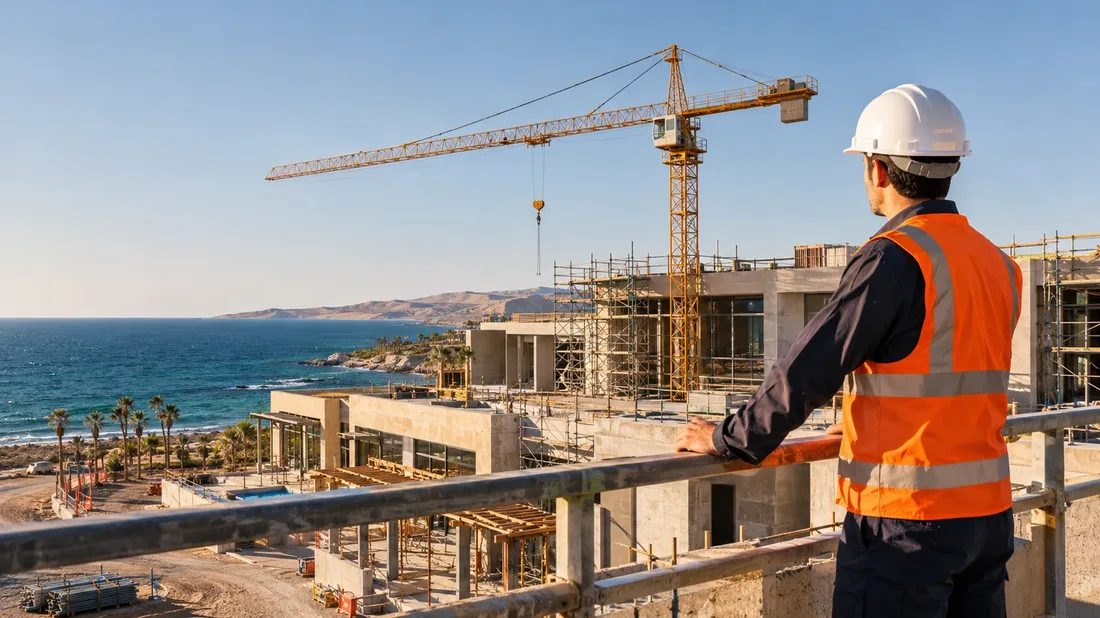
Wynn Resorts has reported a sharp fall in third-quarter profit while continuing to invest in new resort capacity in the United Arab Emirates and Macau. The company is committing money to its next generation of properties as its existing businesses deliver weaker quarterly results.
Net profit attributable to Wynn fell to $17.3m from $88.3m a year earlier, according to results released on 5 November. Revenue was lower at each of its four main resort businesses.
During the same quarter, Wynn contributed another $62.2m to the 40%-owned joint venture developing Wynn Al Marjan Island and surrounding projects, bringing its cumulative cash contributions to $1.12bn. The UAE resort remains scheduled to open in September 2027.
The combination deserves a closer reading than a comparison between one profit figure and one construction bill. Resort development depends on funding commitments, borrowing and cash generated over several years. Wynn's latest quarter tests how comfortably those elements fit together.

What the Profit Fall Tells Us
The three months to 30 September were substantially weaker than the equivalent period in 2025.
| Measure | Q3 2026 | Q3 2025 | Change |
|---|---|---|---|
| Revenue | $1.689bn | $1.834bn | Down 7.9% |
| Net profit attributable to Wynn Resorts | $17.3m | $88.3m | Down 80.4% |
| Adjusted Property EBITDAR | $464.2m | $570.1m | Down 18.6% |
Adjusted Property EBITDAR is Wynn's non-GAAP measure of resort earnings, with adjustments including depreciation, amortisation, rent and other items. It should be read alongside the reported accounts when assessing the business's operating performance.
Revenue fell faster than operating expenses. Operating income consequently dropped 42.6% to $178.2m, leaving less income to absorb financing costs and other charges.
The longer period provides useful perspective. Profit attributable to Wynn for the first nine months rose to $277.8m from $227.3m. The difficult third quarter did not erase the gains recorded earlier in the year.
That makes the direction of current operations more useful than the most dramatic percentage alone. Management needs its resorts to keep generating cash while the next developments consume it.

Three Different Pressures Across the Existing Resorts
The regional figures show several causes behind the weaker quarter.
In Las Vegas, the table-games win percentage was 18.9%, below Wynn's expected range of 22% to 26%. This percentage, often called hold, measures how much of the money exchanged for table-game chips the casino wins over the period. A lower result can reduce revenue even when customers continue playing.
That introduces an element of gaming volatility into the results. It also makes it important to examine customer activity alongside casino winnings when assessing whether a change in earnings will persist.
In Macau, the two resorts together generated revenue of $919.2m and Adjusted Property EBITDAR of $255.3m. Both Wynn Palace and the Wynn Macau property reported lower revenue and adjusted resort earnings than a year earlier. CEO Craig Billings described healthy demand within slower market conditions.
Encore Boston Harbor faced a different operational issue: a strike that began in September. Its quarterly revenue and adjusted resort earnings also declined.
That labour story has since moved forward. NBC Boston reported that UNITE HERE Local 26 and Teamsters Local 25 ratified a new agreement on 5 November, ending the dispute. The settlement changes the position after the reporting period; it does not retrospectively remove the disruption from September's trading.
The recovery in each location will therefore need to be judged on its own evidence. A change in table-game outcomes, a stronger tourism market and the return of striking employees are different influences on future performance.

A History Built Around Expensive Openings
Wynn's development strategy has a long history. Wynn Las Vegas opened in 2005, followed by Wynn Macau in 2006 and Wynn Palace on Cotai in 2016. Each extended the company's resort model into a new location or a larger offering.
That model combines casino gaming with luxury rooms, restaurants, shops, entertainment and meeting space. Construction creates a business expected to earn across those activities for years, with a substantial investment required before the first guest arrives.
Macau's regulatory framework also gives continued development a policy context. The concession that began in January 2023 and runs to the end of 2032 came with commitments to non-gaming projects and event programming, including activities designed to attract tourists and broaden the destination's appeal.
The current building programme sits within that wider evolution of the resort business. More suites and entertainment facilities create opportunities to reach different visitors and increase what they spend during a stay. The commercial return depends on attracting those guests at prices that justify the additional capital.
Continuing a project during a weaker quarter can therefore be rational. The decision still needs to be assessed against the expected return from completing it and the money required from this point onwards.

Two Construction Programmes, Different Timetables
The UAE development takes Wynn into a new market. The company and its local partners announced the Ras Al Khaimah project in January 2022. In October 2024, Wynn announced that the venture had received the UAE's first commercial gaming facility operator licence.
The General Commercial Gaming Regulatory Authority currently lists Island 3 AMI FZ-LLC, trading as Wynn Al Marjan, among its land-based gaming facility licensees. That establishes an important part of the regulatory foundation for the resort.
The current operating target is September 2027. Billings said finishing work and guest-room fit-outs were progressing throughout the property. The development must now move through the remaining stages of construction and preparation for opening.
Macau has a longer horizon. The Enclave at Wynn Palace is a 432-suite tower budgeted at $900m to $950m, including capitalised interest. Construction started in the second half of 2026, with an expected duration of two and a half years.
In its earnings-call comments, management put the theatre and event centre openings in 2028 and the Enclave in early 2029. These are separate projects and targets from the UAE resort's planned 2027 opening.
For Wynn, that means several years of development spending at different stages. The potential benefit is a sequence of new attractions and capacity; the funding requirement arrives before those additions can earn their full contribution.

The Cash Needed Before Opening
The clearest way to assess that requirement is through the cash-flow statement and the funding commitments.
Wynn generated $742.2m of operating cash flow over the first nine months, down from $874.6m. Over that same nine-month period, cash capital expenditure was $533.7m and investment in unconsolidated affiliates was $257.8m. The latter category includes the UAE venture alongside other investments.
These figures show why higher nine-month accounting profit does not automatically mean more money available for expansion. The business has several calls on the cash it generates, while investing and financing transactions also affect its overall cash balance.
The remaining commitment is substantial. Wynn estimates its share of further required cash contributions to the Al Marjan developments at $465m to $590m, including capitalised interest and fees. That estimate includes the related Janu Al Marjan Island hotel and residential development, extending its scope beyond the Wynn resort opening in 2027.
Project borrowing also involves a $2.4bn facility. Wynn's filing describes a completion guarantee given by the company and the Ras Al Khaimah government, adding to the exposure associated with its equity investment.
At group level, Wynn reported $1.64bn of cash and cash equivalents and $10.73bn of current and long-term debt at the quarter-end. Much of that cash sits within its Macau business, which has its own operating, investment and financing needs. The location and availability of funds matter when assessing how the group will meet its commitments.
Returning Cash to Shareholders Remains a Choice
Wynn is also continuing to return money to shareholders. It spent $58.1m on its announced share buyback programme during the quarter and declared another cash dividend with the results.
Those decisions belong in the same assessment as construction spending. Management is choosing how to balance investment, financial flexibility and distributions to owners.
Our recent analysis of Flutter's buyback pause examined another operator's choices between shareholder returns and competing demands on capital. Wynn's physical resort programme gives those choices a different timetable and cost structure.
A project under construction brings contracts and commitments that can make a change of course expensive. Share repurchases can be adjusted more readily. Continuing them indicates management's judgement that the combined spending programme is supportable, a judgement that future cash generation will test.
Our View: the Next Return Matters More than the Next Opening
The case for continuing construction is credible. Wynn has experience building luxury resorts, an established operating base and a licensed opportunity in Ras Al Khaimah. Development decisions with a lifespan measured in decades should take account of more than one difficult quarter.
The weaker cash generation nevertheless makes execution more demanding. The company needs its existing resorts to support investment while managing their own costs, maintenance requirements and financing obligations.
We would assess progress on two fronts. In the current portfolio, the useful evidence will be the strength of customer activity, operating margins and cash generation. In the development programme, it will be control of the remaining costs, delivery against the stated timetable and the quality of demand when the doors open.
The capital already invested establishes the scale of Wynn's commitment. The return on the money still to be spent determines whether completing and operating the projects creates value from here.
That is the question behind these results. Wynn can keep building through a weaker quarter. Its next generation of resorts must eventually earn enough to justify both the construction bill and the financial flexibility committed along the way.
Editorial research and analysis by Lucky BetMastermind, with help from ChatGPT.