

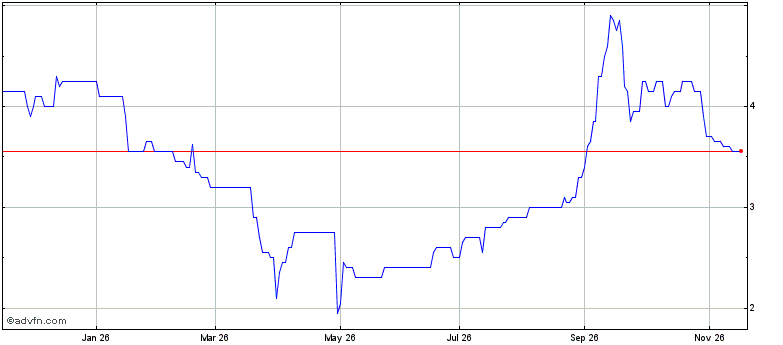
We use B90 Holdings plc’s London AIM ordinary shares as the reference instrument here. Prices need their units, price type and market timestamp. We distinguish the age of a trade from the time a screen refreshes, because a newly loaded page can still display an older observation.

B90 share price and chart
The chart above follows B90 Holdings plc’s London AIM ordinary shares. ADVFN supplies chart images for intraday, one-month and one-year periods. Prices are quoted in GBX. A separate dated reference shows the last closing price we verified with London Stock Exchange / LSEG; it is not presented as a streaming quotation.
When chart data are available, we compare the selected period, currency and adjustment basis before interpreting a movement. A daily closing-price series and an intraday last-trade series answer different questions. Neither the date of this article nor a page reload establishes when an underlying price was recorded.

Which B90 instrument is shown?
The company identifies its AIM ticker and ISIN in its Rule 26 disclosure. Match both when checking a quote, because a company name alone does not identify the trading venue or the kind of instrument being offered.
| Identifier | London ordinary-share reference |
|---|---|
| Issuer | B90 Holdings plc |
| Share type | Ordinary shares; described as NPV in broker listings |
| Market | AIM, London Stock Exchange |
| Ticker | B90 |
| ISIN | IM00BYT32K14 |
| Price notation | GBX or p means pence; GBP or £ means pounds |
| Issuer incorporation | Isle of Man |
NPV means no par value; it does not mean a zero trading price. The company’s place of incorporation and the location of its share market are different identifiers. A reference to London Stock Exchange also does not turn AIM admission into admission to its Main Market.
Provider symbols can use prefixes or suffixes, such as LSE:B90. Keep the London venue attached to the symbol. A quotation from another venue, in another currency, or for a derivative such as a CFD must be identified separately rather than inserted into this share-price series.

How to read B90’s quoted price
GBX is a pence quotation, while GBP is pounds sterling: 100 GBX = £1. Divide a GBX price by 100 to express the same price in GBP. The currency used in B90’s corporate accounts does not determine the unit of its London share quotation.
Teaching example, not a B90 quotation: 10 GBX per share equals £0.10 per share. Labelling the unchanged number as £10 would make it one hundred times too large. Apply the conversion once, including when calculating the sterling value of a holding or market capitalisation.
| Field | What it describes | What it does not establish |
|---|---|---|
| Last trade | The most recently reported transaction in the defined series. | A price available for a new order now. |
| Bid | The quoted buying side of the market, relevant to someone selling. | Guaranteed execution for any quantity. |
| Offer / ask | The quoted selling side of the market, relevant to someone buying. | The full cost after dealing charges. |
| Previous close | The provider’s closing reference for the previous session. | Necessarily the same value as the last reported transaction. |
| Change / change % | Movement against the stated comparison value. | An investment return including every fee or distribution. |
| Volume | Shares traded over the stated interval and market coverage. | A cash value, or proof that all trading venues are included. |
We follow the provider’s definition of its headline price. A field labelled simply “price” may use a bid-offer midpoint rather than the last trade. We retain that distinction instead of treating every headline price as a transaction. Likewise, do not combine one source’s bid with another source’s offer to calculate a spread.
The spread is the gap between comparable bid and offer quotations. It helps explain why buying and immediately selling can produce different prices even if the headline price has not moved. The displayed quantity, age of the quote and execution terms still matter.

Timing, market capitalisation and context
Market time and missing values
Separate the time of a trade or quote from the time a website fetched or displayed it. Delayed data carry the provider’s stated delay; refreshing a page does not remove that delay. A last trade can also be older than the most recent quote update when no newer transaction has been reported.
Time-zone labels matter. Use the source’s named zone or explicit UTC offset, rather than assuming that the reader’s local time is London time. If the delay or timestamp is unknown, that uncertainty should remain visible. A market-closed label describes a session state, not a guarantee that a particular field is the official closing price.
Unavailable data and an unchanged price are different states. A failed chart should show an explanation. An older retained observation needs its original timestamp and a last-available label; it must not acquire a new market time merely because the page refreshed. A missing series should not be replaced with a flat line.
Issued capital and wider context
B90’s Rule 26 page reports 440,814,739 ordinary shares in issue as at 31 July 2026. Reading that page on 17 November does not change the capital date. This figure is a dated reference, not an independently confirmed current share count.
For market capitalisation, we multiply the relevant share price in pounds by the corresponding number of shares. A calculation must identify both inputs and their dates. Share options outstanding are not automatically shares already issued. A provider’s market-cap figure can also differ because its price basis or capital record differs.
The number of shares in issue does not explain who controls them. Ownership disclosures, financial results and business risks require separate evidence; none can be established from a daily price chart alone. Share-chat opinions and analyst expectations likewise need their own authors, dates and assumptions. They do not turn historical price movements into a forecast.
Source and method: instrument identity and dated issued capital were checked against B90’s Rule 26 page on 17 November 2026. Price-field explanations use London Stock Exchange guidance and provider labels. Chart images are supplied by ADVFN, with controls for the displayed period. The separately labelled closing-price reference retains its original trading date and source. This research is not an investment recommendation.