
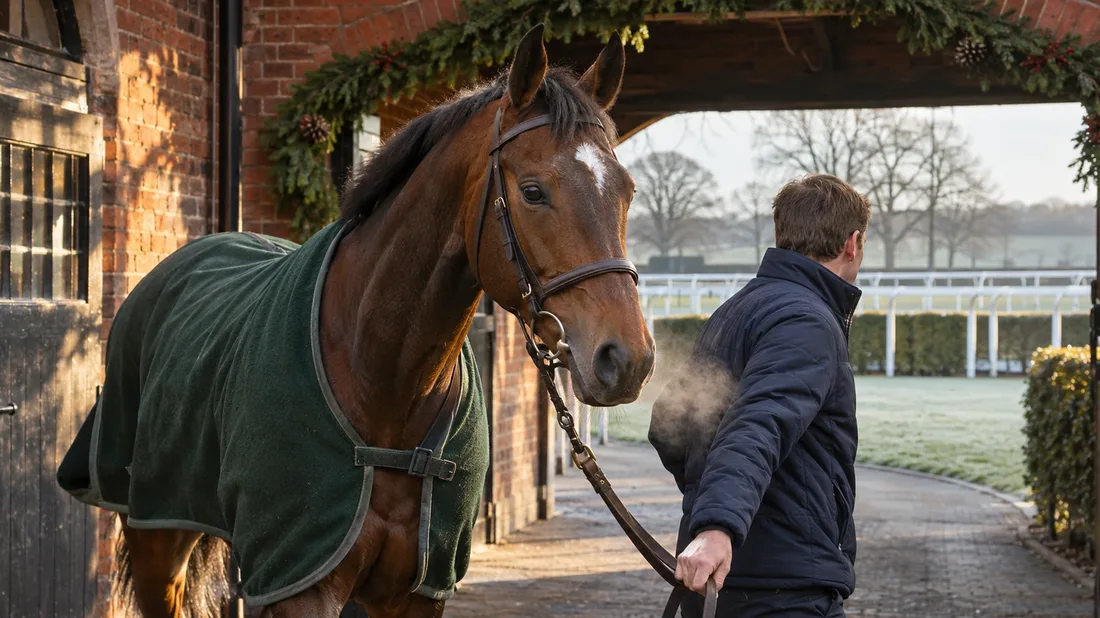
Entain is bringing Ladbrokes and Coral’s Christmas racing partnerships together through The Festive Four, a programme of meetings at Kempton Park, Chepstow and Newbury running from 26 to 29 December 2026.
The group outlined the initiative on 6 November, following announcements by racecourse partners on 5 November. ITV will show racing across all four days, with a different feature race heading each day’s programme.
The launch comes as racing reassesses the durability of bookmaker sponsorship. Entain’s approach combines established races, television coverage and a shared identity. Its commercial significance lies in how those assets work together. The announcement does not disclose the sponsorship budget or establish its eventual return.

What The Festive Four actually is
The name describes a coordinated programme across three racecourses, with Kempton hosting the first two days. It brings existing meetings into a more clearly sequenced Christmas schedule.
| Date | Racecourse | Headline race |
|---|---|---|
| 26 December | Kempton Park | Ladbrokes King George VI Chase |
| 27 December | Kempton Park | Ladbrokes Kauto Star Chase |
| 28 December | Chepstow | Coral Welsh Grand National |
| 29 December | Newbury | Coral Challow Hurdle |
There is also a joint admission product: the limited Festive Four Pass costs £64 for all four days, with the advertised offer running until 15 December. Trophies for the leading jockey and trainer provide a competition running through the programme.
Entain’s Simon Clare presents the initiative as a way of giving each major meeting greater attention and reaching a wider Christmas audience. Newbury Racecourse chief executive Shaun Hinds has welcomed the Coral Challow Hurdle meeting’s position as the finale, alongside the course’s continuing relationship with Entain.
Those statements describe the organisers’ ambitions. The December meetings will provide the evidence of how audiences and racegoers respond.

The important change was agreed in July
The background predates the November branding. On 2 July, the British Horseracing Authority confirmed the fixture changes underpinning the four-day television programme.
Kempton retained 26 and 27 December, with the Kauto Star Chase moving to the second day. Chepstow’s Welsh Grand National meeting shifted to 28 December, removing its clash with Kempton on the 27th. Newbury’s Challow meeting received a fixed place on 29 December.
That separation matters to people working within racing as well as those watching it. Trainers, jockeys and owners have fewer competing demands around the two major meetings. Broadcasters can give each feature a clearer place in the sequence, while racecourses can promote a recognisable destination for each day.
The BHA said Entain initiated the collaboration and Racecourse Media Group helped broker it. The partners span different organisations: The Jockey Club operates Kempton, Arena Racing Company operates Chepstow, and Newbury brings its own commercial interests to the arrangement.
In the July announcement, BHA director of racing Richard Wayman linked the changes to retaining and growing racing’s audience through free-to-air television.
The work therefore reaches beyond attaching another sponsor’s name to a race. The participants have adjusted the calendar and coordinated how they present it. That creates a practical basis for the marketing claim, even though it cannot establish the financial outcome in advance.

Old racing assets under a common owner
The events already possess substantial sporting recognition. The King George VI Chase was first run in 1937. Its history includes Desert Orchid’s four victories and Kauto Star’s record five wins, making Kempton’s Christmas meeting familiar well beyond a single season’s promotion.
Coral’s Welsh Grand National relationship reaches back to its first sponsorship on 17 February 1973. The association has survived successive generations of horses, customers and racing management.
Those histories help explain the opportunity. A sponsor can build on recognition already created by the sport and by its own previous involvement. A coordinated programme may make that accumulated association easier to communicate across several days.
The corporate structure also matters. GVC completed its acquisition of Ladbrokes Coral in 2018 and adopted the Entain name in 2020. Ladbrokes and Coral now sit within one group, allowing the owner to support a common programme while retaining distinct names on the individual races.
Our reading is that The Festive Four makes use of that portfolio. Ladbrokes remains prominent at Kempton, followed by Coral at Chepstow and Newbury. The shared identity gives the sequence a connecting story without requiring the established race names to disappear.

Heritage still has to earn its place in a marketing budget. A long association can make a sponsorship valuable, but its history alone cannot establish the return from renewing or expanding it.

Why the Betfred comparison matters
Our earlier report, Betfred declines Classics renewal as tax pressure reaches racing, examined a different decision: Betfred declining a proposed three-year renewal covering all five British Classics, while attributing its position to tax pressure.
The distinction between the two announcements is useful. Betfred’s decision concerns future commitments around major Flat races. The Festive Four concerns jump racing over Christmas, supported through relationships already associated with Ladbrokes and Coral.
Entain has not announced that it is replacing Betfred at the Classics. The available information also does not show that its programme compensates racing for any particular amount of sponsorship income that will be lost.
The comparison instead suggests a more selective market for bookmaker spending. An operator may judge one set of rights difficult to justify while another sees value in a different audience, calendar position or promotional format.
Companies also have different product mixes, existing commitments and priorities. Their decisions cannot be reduced to a simple test of which business cares more about racing.
For racecourses, this makes the proposition they offer more important. Prestigious names remain useful assets, but sponsors need a reason to believe the rights can produce results. Organising familiar fixtures into a clearer sequence is one possible way to improve that proposition.

The commercial case depends on the audience
There is a plausible logic to four consecutive days of coverage. Someone attracted by Boxing Day’s King George can be given a clear reason to follow the next day’s racing, then Chepstow and Newbury. The shared identity may help ITV and the courses explain that progression.
For Entain, the opportunity is repeated association with a period already important to racing. The Ladbrokes and Coral names remain attached to the feature races, while the wider programme provides a consistent subject for promotion.
That is an argument about potential value. The announcements do not provide a sponsorship fee, a detailed marketing budget or a forecast that can be independently tested. A claim that Entain has increased its racing expenditure by a particular amount would go beyond the evidence.
Nor does four-day television coverage automatically demonstrate additional profit. The relevant questions include how many people watch, how many return on subsequent days and whether the programme attracts people who would otherwise have paid little attention to racing.
Attendance needs a similar assessment. A joint pass may encourage visits to more than one course, but its effect depends on how many purchasers attend and whether those visits add to existing demand. Selling a package and increasing overall attendance are related measures, with different implications.
The £64 price is consequently part of the access strategy, rather than proof that the programme has already broadened its audience. Travel between three venues also makes attending all four days a larger undertaking than the admission price alone suggests.

Weather and delivery remain practical risks
The sporting product has to survive the conditions in which it is staged. A coordinated television programme depends on meetings going ahead and on organisers explaining changes clearly when they do not.
Chepstow’s published pass FAQs address abandonment. If one fixture is abandoned, the stated arrangement provides a ticket for another similar meeting at that racecourse. If two or more are abandoned, the terms provide a full refund while allowing attendance at the remaining fixtures.
Those provisions are a reminder that packaging several days together creates customer expectations across several venues. The strength of the offer will depend partly on how the partners handle disruption and communicate responsibilities.
There is also a longer-term question. An attractive Christmas sequence does not resolve the funding challenges facing the rest of the fixture list. Its success would provide evidence about this format, rather than establishing that every racecourse or sponsorship can reproduce the result.

Our view: coordination gives sponsorship more to work with
The strongest part of The Festive Four is the attempt to improve what the partners are selling. Removing a fixture clash, fixing a finale and making the sequence easier to follow are tangible changes that a sponsor and broadcaster can use.
That is a constructive response to pressure on racing’s commercial model. It gives the sport something specific to evaluate: whether a clearer programme makes its existing assets more attractive to viewers, racegoers and partners.
We would judge the initiative through audience retention across the four days, attendance, the performance of the shared pass and the partners’ willingness to continue the arrangement on sustainable terms. The value of those measures will depend on comparable information from earlier Christmas periods.
Betfred’s decision against renewal and Entain’s participation in this programme show why individual agreements deserve close attention. Racing’s relationship with bookmakers continues to develop through decisions about particular rights, products and audiences.
The Festive Four offers an opportunity to strengthen one of the sport’s most recognisable periods. December’s results will show whether the collaboration has made that opportunity more valuable.
Sources and evidence
- Entain, Entain leads racing collaboration to launch ‘The Festive Four’, 6 November 2026. Programme, sponsors, pass offer, trophies and participant statements.
- Newbury Racecourse, “The Festive Four”, New Four-Day Christmas Racing Programme Unveiled, 5 November 2026. Announcement and Shaun Hinds’s role and comments.
- British Horseracing Authority, BHA confirms ITV-backed changes to Christmas period fixtures, 2 July 2026. Fixture changes, industry coordination and Richard Wayman’s comments.
- The Jockey Club, Kempton Park, King George VI Chase, accessed 9 November 2026. Race history and the records of Desert Orchid and Kauto Star.
- Chepstow Racecourse, Track Talk by Phil Bell, 14/12/22, 14 December 2022. Coral’s first sponsorship on 17 February 1973.
- Entain, History, accessed 9 November 2026. Ladbrokes Coral acquisition and the group’s change of name.
- Chepstow Racecourse, Festive 4 FAQs, dated 30 October 2026, accessed 9 November 2026. Offer deadline and published abandonment arrangements.
- SBC News, Entain spearheads launch of racing programme in welcome boost for the sport, 9 November 2026. Contemporary industry coverage; the programme itself was announced earlier.