

FanDuel restricted sports, political and novelty event contracts (contracts whose payout depends on whether a specified event happens) in Utah on 30 October, while keeping economic and financial contracts available. Contracts customers already hold will remain open and settle as expected, the company told SBC Americas (a news outlet within Sports Betting Community).
For British readers, the corporate name behind that decision is familiar. FanDuel belongs to Flutter Entertainment, the group behind Paddy Power, Sky Bet and Betfair. Its American business is testing a route to customers in states where conventional online sportsbooks (services that take bets on sport) cannot yet operate.
Flutter has explicitly described prediction markets (markets where people trade contracts on future outcomes) as a way to acquire customers ahead of sports betting regulation. Utah now puts a practical question against that strategy: how useful is early access if the products available to those customers can change while regulators fight over who is in charge?



Why Flutter wanted this route
FanDuel Predicts launched on 22 December 2025 with CME Group (CME stands for Chicago Mercantile Exchange). CME Group operates markets for derivatives (financial contracts linked to underlying assets, prices or events). The partnership gave the betting brand a separate app for trading event contracts. The announced plan included sports contracts in states without legal online sportsbooks, outside tribal lands.
The mechanics are straightforward enough to recognise. A customer takes a “yes” or “no” position on an event, such as a sporting outcome. FanDuel’s launch announcement described contracts priced between one and 99 cents. The legal argument is over which regulatory framework governs them.
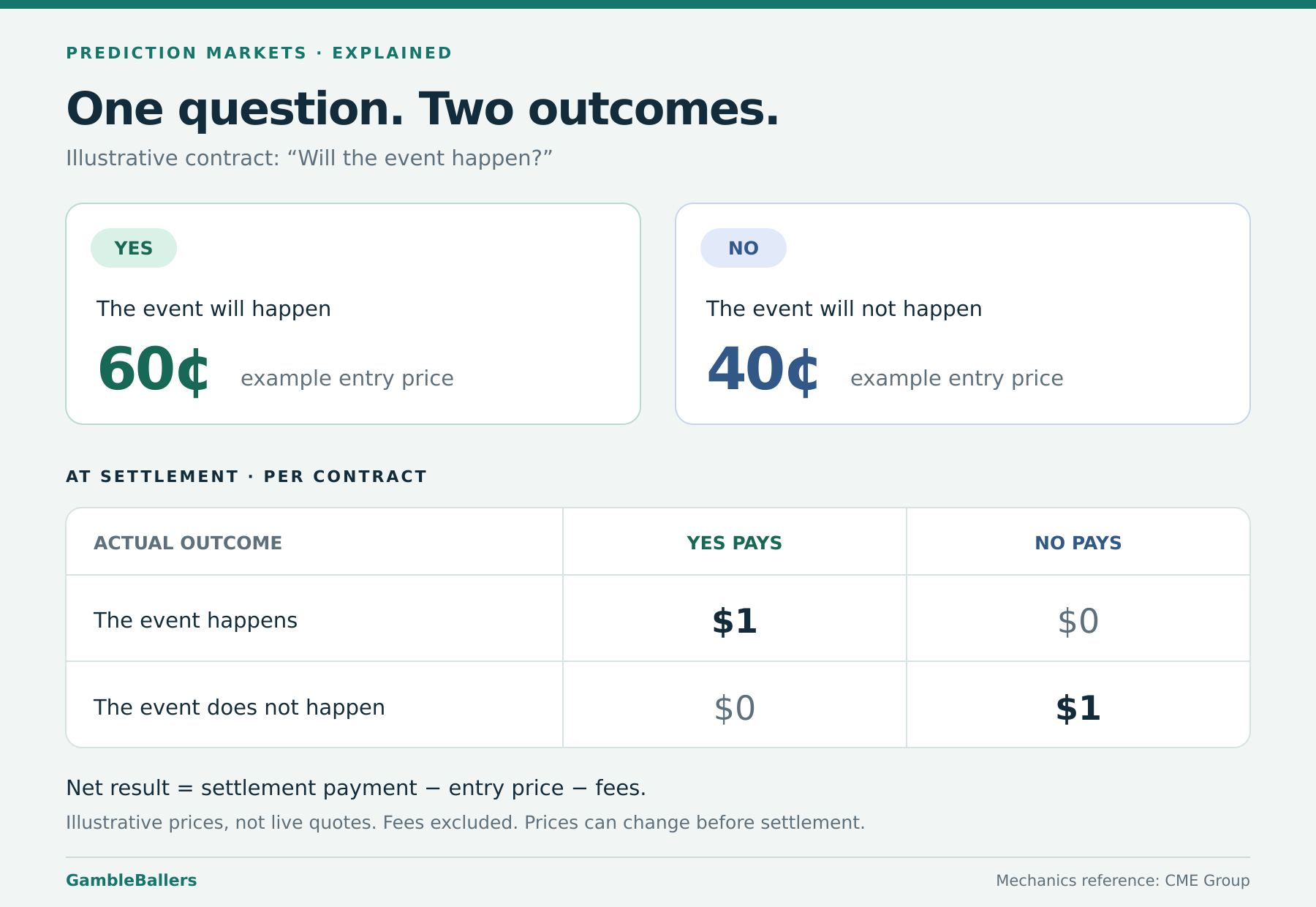
Read the example
Illustrative entry prices: YES 60¢; NO 40¢.
| Outcome | YES pays | NO pays |
|---|---|---|
| The event happens | $1 | $0 |
| The event does not happen | $0 | $1 |
Net result equals the settlement payment minus the entry price and fees.
The launch plan also said FanDuel would stop offering sports contracts in a state when that state legalised online sports betting. The product was therefore designed to fit around the sportsbook’s geographical footprint, with a different offering where the conventional business had yet to gain entry.
Flutter’s filing for the first quarter of 2026 made the commercial logic unusually clear: prediction markets offered an additional way to win customers before new states regulated sports betting. That is a strategy for attracting customers as well as a product launch.
Our reading is that Flutter wants to reduce the time needed to build an audience when a new sportsbook market opens. A customer who already knows FanDuel may be easier to reach later. That potential advantage depends on the earlier product remaining available and useful; it does not guarantee that a trader will become a sportsbook customer.

A legal fight becomes a decision about the app
Utah makes a sharp test of the model because it has no legal sportsbook market. FanDuel was reaching eligible customers there through its prediction product. Its October decision narrowed what that product could offer.
The change followed an escalation around Kalshi. On 28 October, Reuters reported that Utah had charged the prediction market operator and its two co-founders with promoting illegal gambling. Kalshi said it would challenge the prosecution.
The federal regulator is taking the opposing side on jurisdiction. On 27 October, the Commodity Futures Trading Commission (CFTC) announced a lawsuit seeking to block Utah’s enforcement against federally regulated prediction markets. The CFTC argues that federal derivatives law gives it exclusive authority over the relevant contracts and displaces state gambling rules.
State authorities contest that interpretation. In a 29 October announcement, California’s attorney general described a coalition’s brief supporting Utah in Kalshi’s appeal, arguing that state gambling protections should remain enforceable. The two sides disagree over who has the power to supervise and restrict the same activity.
DraftKings also confirmed restrictions on sports, political and novelty contracts in Utah to NEXTPredict (a prediction market news outlet). The operational response therefore extends beyond FanDuel, even while the companies retain financial contracts.
FanDuel’s launch plan envisaged sports contracts giving way when a state opened its sportsbook market. Utah’s restriction has arrived while that market remains closed. The result is a smaller offering during the very period when Flutter hoped to build customer relationships ahead of legalisation.

Britain already knows the exchange model
The American argument can make prediction markets sound like an entirely new category. For a British reader, the customer model has a familiar reference point: the betting exchange (a platform where customers bet against one another rather than the bookmaker).
In guidance published on 4 February 2026, the Gambling Commission said prediction markets would, depending on their business model, appear to fall within the betting intermediary category in Great Britain. That is the category used for exchanges. Products meeting the definition of gambling require a Commission licence. Financial services and spread betting (where gains or losses depend on how far a price or result moves relative to the quoted level) sit within the framework of the Financial Conduct Authority (FCA), Britain’s financial services regulator.
The Commission also drew a distinction between Britain’s established sports betting market and the United States (US) system of regulation by individual states. It said it did not believe operators launching the current prediction market products in Great Britain could classify them as non-gambling.
That changes the commercial context. In America, a prediction product can be pitched as a way to reach customers beyond a sportsbook’s existing territory. In Great Britain, a product that falls within gambling regulation enters a market that already has licensed bookmakers and exchanges. The American expansion story does not translate automatically into a new British market.

Betfair encountered the border problem years ago
Flutter’s own portfolio provides an older comparison. On 3 June 2010, the Court of Justice of the European Union (CJEU) ruled in Sporting Exchange, trading as Betfair, v Minister van Justitie, case C-203/08. Betfair had challenged Dutch authorities over market access and argued that licences granted elsewhere in the European Union (EU) should be recognised.
The court held that EU law did not prevent the exclusive licence system at issue from excluding other online operators. Permission in another member state did not automatically secure access. National restrictions still had to satisfy proportionality requirements, and licence procedures were subject to rules on equal treatment and transparency, with exceptions for operators under close state control.
That judgment predates Brexit and concerned the Dutch regime then in force. It does not determine the US dispute over federal and state powers. The useful comparison is commercial: a brand now within Flutter had already encountered the gap between being able to deliver an online product and being entitled to serve customers in a particular territory.

The next test is whether access lasts
An early customer base is only valuable if the operator can maintain a relationship with it. A shrinking range of contracts could make that harder, even where the app and its financial markets remain available.
Utah illustrates the uncertainty within that opportunity. An operator can launch a product, attract customers and then narrow its offering while the legal dispute continues. For the customer, that means the range of available contracts can change. For the business, it complicates the promise of building a lasting relationship ahead of a future sportsbook launch.
Our view is that the most revealing measure here is the durability of market access. Flutter’s strategy needs time to turn an early presence into a useful customer base. The decisions to watch are court orders on enforcement and further changes to what operators actually offer. In Utah, the argument about authority is continuing, but the change to FanDuel’s product has already happened.