
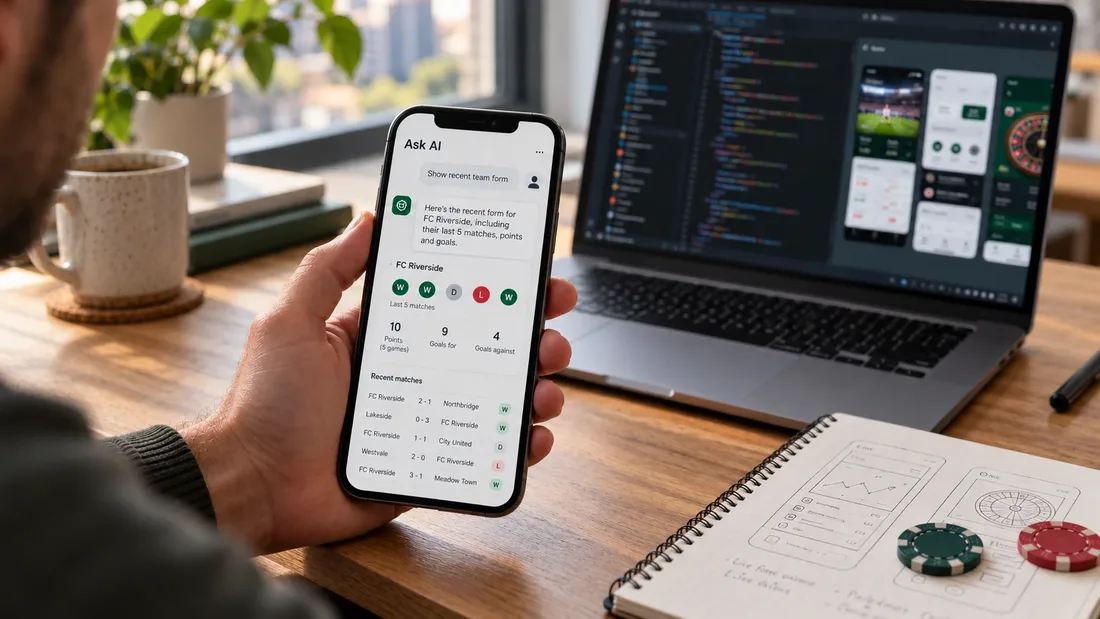
At Sportsbet, an AI assistant can turn a customer's question into sporting statistics and suggested betting options. At Betsson, executives report that one team's development cycle fell from 80 days to five after it redesigned its workflow around AI.
Together, these examples show how AI is changing both the customer experience and the work behind it. It is shortening the journey from a question to a selection, from an enquiry to a response, and from a product idea to a working feature.
Examples from Flutter Entertainment, Betsson and evoke show what this means in practice: conversational betting, more tailored casino discovery, assistance for customer-service staff and faster development work. The gains are specific to each task, with different implications for the operator and the player.
Customer service staff get help before they reply
Sportsbet's Jeeves tackles a different task. Flutter's September 2026 case study describes an internal tool that interprets informal customer messages, checks account context and proposes a response or action for a customer relationship manager to review.
For example, an informally worded request for an offer can be recognised, assessed and turned into a draft reply. The employee can accept or change the recommendation. Jeeves has its own data platform, integrated with Salesforce, so the work appears inside the staff member's existing customer-management system.
Flutter reports that the number of customers in each relationship manager's portfolio rose from 400 to 1,200 while customer satisfaction remained stable. For customers, the intended benefit is a service team with more capacity to handle enquiries. For the business, the reported result is more customers served by each manager.
evoke reports a broader move into such workflows. Its 2025 annual report says more than 60 AI and automation solutions entered production during the year, mainly in Customer Operations, Risk and Trading. Across the group, those solutions executed more than 4.4 million operational tasks and process steps.
Those figures combine AI and other automation. They describe activity at scale, rather than isolating how much improvement came from a language model. The distinction matters: a chatbot, an automated check and a workflow that moves information between systems can all contribute to the same customer interaction.
In casinos, AI also changes what players see
A casino does not need a conversational assistant to use AI. In its 2024 annual report, evoke described Casino Explorer at 888casino: players could browse gameplay preview videos, with AI personalisation determining the order shown to each player. This is an earlier documented example of AI shaping discovery in a casino lobby.
The task is to help someone find their way through a large catalogue. A tailored order can make relevant games easier to discover. For the operator, it changes which content gets attention and gives the business a way to shape the browsing experience. The disclosed application concerns presentation and discovery.
AI is also becoming part of game production. In Flutter's July 2026 report on its TechConnect event, tombola technology director Karl Wood described generative AI assisting game-design and animation work. That places AI earlier in the process, helping the team create what players will eventually see. It is a different role from ranking an existing catalogue.
Development is getting faster at specific stages
Betsson's example shows why the development story extends beyond generating code. In a May 2026 interview with NEXT.io, its technology leaders described a team working on retention and engagement systems, including bonus and tournament mechanics. The team split into smaller units and redesigned its workflow with AI helping refine specifications and guide the next steps.
The reported development cycle fell from 80 days to five. This was one team's case, involving changes to organisation and process alongside AI. It gives a concrete example of shorter delivery time. It does not describe the creation of an entire gambling platform in five days.
Flutter describes a smaller task with a similarly clear boundary. Its February 2026 GenAI update says a Sportsbet business-analysis agent turned plain-English feature requests into structured specifications, reducing work that had taken six hours to roughly one.
Specifications sit between an idea and implementation. If that handover becomes quicker, developers can begin with a clearer description and spend less time translating a request into a task. The time saved belongs to that stage; it is not a measure of the speed or quality of the whole release.
Betsson's own interview with data and AI director Cleber de Lima describes AI initiatives spanning product discovery, software development, and content and design. The common opportunity is removing repetitive work across a chain of tasks. Evaluating the result still requires checking what was delivered, how well it works and how it is maintained.
Why companies still need their platforms and engineers
These tools work because they connect to an operating business. A betting assistant needs sporting data, available markets and account permissions. A service assistant needs relevant customer context. Development tools need access to the requirements and systems that engineers actually maintain.
Flutter's account of AceAI illustrates the scale of that integration. The company says a team of around 20 engineers, AI specialists, product managers and designers took roughly a year to bring it from concept to launch, with security and compliance input. The team used large language models provided through Amazon Web Services.
In that model, the operator develops its own product and integrations while using externally supplied models. AI can make individual jobs quicker while the wider project still demands engineering, testing and operational controls.
That helps explain the interest in technology ownership discussed at SBC Summit in Lisbon, held from 29 September to 1 October 2026. SBC News's report on the executive panel highlighted shared expertise and proprietary technology. The practical examples show where that control matters: connecting AI to data and turning a useful experiment into a feature that can operate inside the business.
For British readers, Flutter Entertainment also connects these developments to familiar brands including Paddy Power and Sky Bet. A feature's availability still needs to be checked for the particular brand and market; a Sportsbet or FanDuel release has its own scope.
What the customer gains, and who keeps control
The immediate customer benefits are practical: finding statistics without changing screens, browsing a catalogue more easily and dealing with staff who have relevant information prepared. For operators, the same tools can improve service capacity, shorten development work and keep more of the customer journey inside their own product.
Those interests overlap, but they are separate outcomes. Faster discovery is convenient; its effect on the quality of a customer's gambling decisions requires separate evidence. Likewise, a shorter development cycle needs to be judged alongside the reliability and usefulness of the released feature.
Control is part of the design. FanDuel says customers decide which AceAI selections enter their betslip. Prompts suggesting harmful behaviour can lead to safer-gambling information and specialist review. Behind the scenes, Flutter also describes AI models in Sportsbet's Real-Time Intervention and FanDuel's Real-Time Check-In, flagging unusual deposit behaviour so staff can prompt a customer to reflect.
These examples suggest that AI's most immediate impact lies in connecting the steps people already take. It can help customers find information, staff respond to enquiries and developers turn requirements into working features. The meaningful test is what happens at each of those steps: whether the answer is grounded in useful data, the customer retains control and the finished product works better.