
Gamble Ballers · News analysis · Continuing coverage
Bally’s Faces a Delivery Test at the A’s Las Vegas Stadium
Nevada approved corporate applications linked to Evoke while pressing Bally’s on its Strip commitments. The practical question is how access, parking and utilities will be funded and ready for opening day.
In this article
Nevada Gaming Control Board chair Mike Dreitzer pressed Bally’s Corporation chairman Soo Kim on 19 November over the company’s ability to deliver its obligations around the Athletics’ Las Vegas ballpark. Kim said the work would be ready for the stadium’s planned April 2028 opening, according to CDC Gaming’s account of the hearing. The exchange puts construction responsibilities and priorities at the centre of Bally’s expansion story.
CDC reported that Kim said Bally’s would cover an initial $250m in financial obligations for non-gaming elements associated with the ballpark. That was a statement of the company’s intended commitment. The funding structure and coordination with the Athletics and property owner Gaming and Leisure Properties, or GLPI, remain part of the delivery challenge.
Our 19 November analysis of Bally’s financing and liquidity examined how new capital commitments relate to existing payments and development plans. The Las Vegas hearing develops that issue at project level: which work has to be completed, who is responsible and when the money must become available.
The podium is part of the stadium’s opening plan
The former Tropicana site is being redeveloped around a ballpark and a wider commercial district. The old hotel-casino was demolished in October 2024. Reporting on the current plans describes a phased development, with the casino-resort coming later. The stadium and the eventual resort consequently have different construction programmes and purposes.
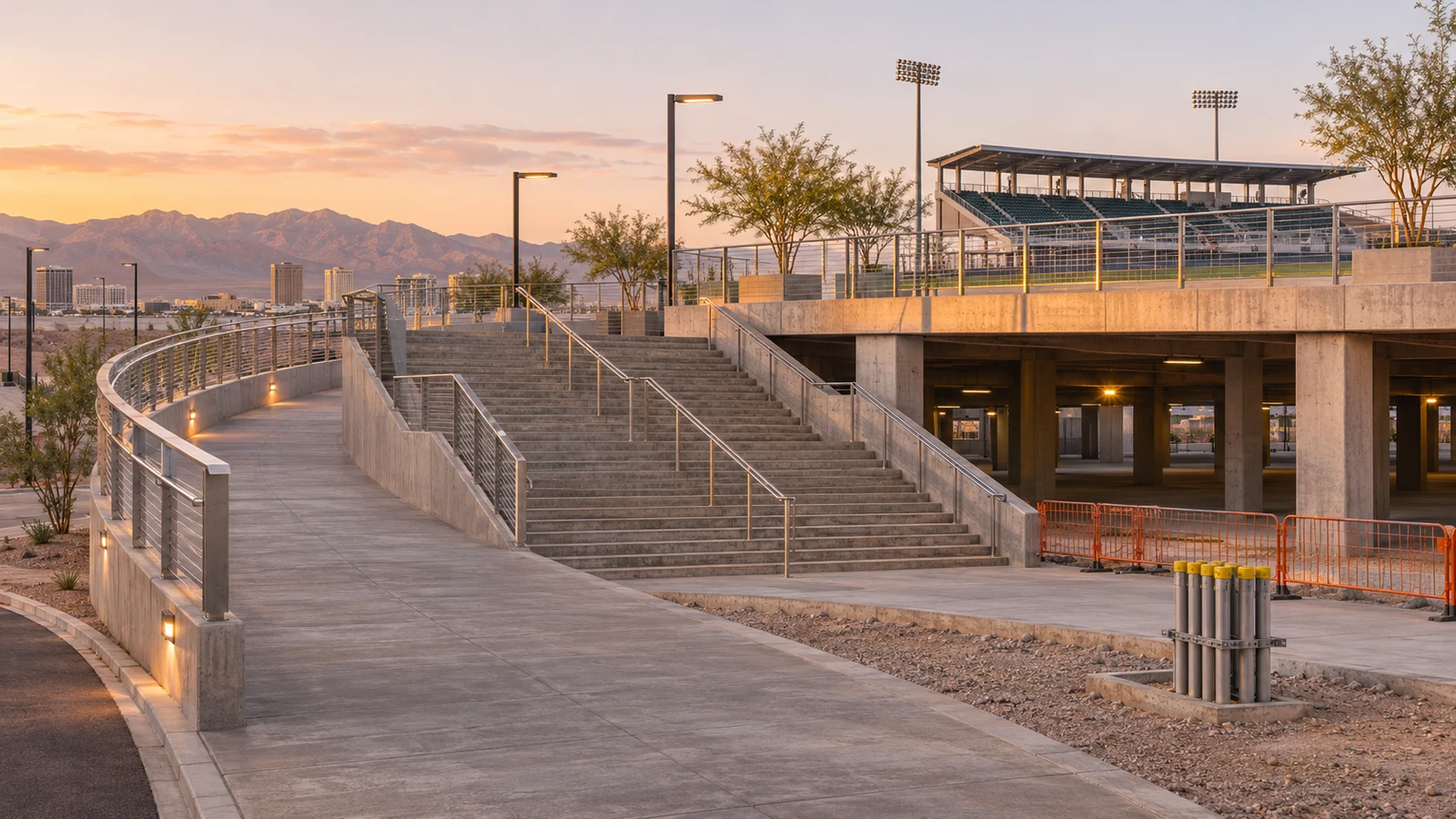
The Stadium Authority’s 4 November agenda material explains the physical dependency. The multi-level podium includes a plaza and parking and is intended to connect the Las Vegas Strip and Tropicana Avenue to the stadium’s main entrance, more than 35 feet above ground level. It is a functional part of getting people to the venue.
That creates an important sequencing issue. The access works have to support the ballpark’s opening even if later commercial phases follow a different timetable. Progress on the stadium structure alone cannot establish whether all of the surrounding works needed for visitors will be ready. Each element needs its own funded route to completion.
Three parties need one workable delivery programme
The three-party structure has a history. GLPI’s quarterly filing describes the 2023 letter of intent involving GLPI, Bally’s and the Athletics: the team would bear stadium design and construction costs, while Bally’s would pay for the resort redevelopment. GLPI contemplated funding certain site preparation and minimum public spaces. That framework helps explain why the parties must agree how adjacent work is funded and delivered.
At the hearing, Kim emphasised that Bally’s, GLPI and the ballclub all had to agree on the route forward. The Nevada Independent also reported that discussions about the funding structure were continuing after the hearing. A commercial incentive to finish the work is useful, but the practical programme still needs agreed responsibilities and payment arrangements.
For our assessment, a useful delivery plan would connect the work with the money and the date on which the stadium needs it:
| Delivery element | What would demonstrate progress |
|---|---|
| Funding | Agreed sources and drawdown dates for the specified infrastructure. |
| Construction | A named responsible party, contractor programme and dependencies between work packages. |
| Handover | Dated completion and acceptance milestones tied to the planned stadium opening. |
Coordination matters because one completed package can still depend on another. A finished arrival plaza needs the right connections; parking needs usable access; utilities have to be available when the facilities are commissioned. The value of a combined programme is that it makes those handovers visible and assigns responsibility for resolving conflicts.
Evoke approvals came with a separate time limit
The special hearing concerned corporate applications connected with the Evoke acquisition through Bally’s Intralot. The Nevada Gaming Commission’s published disposition records approval. It also limits the approvals of Bally’s Intralot, its two named Jersey intermediaries and its chief executive, Robeson Mandela Reeves, to 30 April 2027. These are specified corporate-registration and suitability approvals, with their own scope.
The regulatory and construction timetables therefore need to be read separately. The April 2027 condition applies to the identified approvals, while the April 2028 target concerns the planned ballpark opening and supporting works. The published record shows the corporate applications moving forward alongside close scrutiny of Bally’s project commitments.

A busy development portfolio makes priorities consequential
Dreitzer’s questioning placed Las Vegas alongside Bally’s work in Chicago and New York and its acquisition activity. His concern, as reported by CDC Gaming, was whether the company could responsibly finish the projects it had started. That is an execution question involving management capacity and coordination as well as access to finance.
Funding arranged for a particular borrower or development has its own conditions and uses. The useful comparison is between those terms and the dates when construction payments fall due. A group-wide financing announcement cannot by itself establish that a specific stadium-access package has an agreed budget, a contractor ready to proceed and all partner decisions in place.
For visitors and neighbouring businesses, the practical test is whether people can reach and use the venue as planned. A successful opening requires the stadium and its supporting infrastructure to work together. That gives the access programme a public significance extending beyond the commercial appeal of a future casino-resort.
Our assessment: confidence needs funded milestones
In our view, Dreitzer’s emphasis on responsibility addresses the central dependency in this project. The minimum infrastructure needed for the ballpark has to be planned around its opening date, while later resort phases can have their own commercial timetable. Bally’s strongest response would be a coordinated programme showing how those essential works will be funded, built and handed over.
Kim’s commitment makes the intended outcome clear. Evidence of agreed funding for named work, progress against contractor milestones and an accountable handover plan would make that assurance easier to assess. For a company expanding across several markets, completing the infrastructure on which its partners depend would be a concrete demonstration of its ability to deliver.
Sources
CDC Gaming, 20 November 2026: reporting from the 19 November hearing, including Kim’s commitment and Dreitzer’s concerns.
Nevada Gaming Commission, 19 November 2026 disposition, nonrestricted items 18-19, PDF pp. 18-23: approvals and the 30 April 2027 condition.
Nevada Gaming Control Board, special disposition, 19 November 2026, item SP01: the Board’s recommendation and specified approval limit.
Las Vegas Stadium Authority, agenda book, 4 November 2026, item 1, PDF p. 8: purpose and location of the podium.
GLPI, Q3 2026 Form 10-Q, Note 1, Tropicana Las Vegas lease: historical land and development framework.
iGaming Business, 20 November 2026: hearing context and redevelopment of the former Tropicana site.
The Nevada Independent, 19 November 2026: hearing and post-hearing reporting on the continuing three-party funding discussions.