

Light & Wonder is a gaming technology supplier, not an online casino taking deposits from British players. Its business covers gaming machines and systems, digital real-money game content and social or casual mobile games. But a game on a casino website, a famous slot title and a registered subsidiary are three different things.
The distinction matters when researching Light & Wonder subsidiaries. Its FY2025 Form 10-K includes a subsidiary schedule, while the commercial catalogue spans studios, platforms, licensed franchises and games distributed through independent operators. Our Light & Wonder company overview gives the broader picture.
| Reported business | What it provides | How to read its brands |
|---|---|---|
| Gaming | Land-based machines, cabinets, table products, systems and Grover charitable gaming | A cabinet or slot family is a product, not necessarily a company |
| SciPlay | Social casino and casual digital games | The apps use virtual game currencies; they are not cash-out casinos |
| iGaming | Real-money casino content, game development and distribution platforms | An operator carrying content is a customer or partner, not automatically a subsidiary |

What does Light & Wonder own?
Light & Wonder, Inc. is the listed parent reporting the three segments. The group includes acquired studios, SciPlay companies, operating businesses and holding entities, alongside products without separate legal identities.
The clearest legal baseline is Exhibit 21 of the FY2025 Form 10-K. Its schedule identifies subsidiaries in which Light & Wonder holds at least 50%. It lists 68 entities and states that they are wholly owned unless otherwise noted. Two named exceptions are Barcrest Development B.V. (50%) and LNW Gaming Africa Proprietary Limited (74.8%).
These are interests held within the group, not proof of direct parent ownership of every company. The FY2025 filing does not guarantee an unchanged structure throughout 2026; some entities are holding companies.
The group filing establishes reported subsidiaries; registries identify specified legal control; company announcements explain commercial products.

Brands, studios, platforms and games: the key differences
Studios may release games through platforms carrying third-party content. Casinos offering those games do not thereby own their developers or underlying intellectual property.
| Name or example | Correct classification | Ownership implication |
|---|---|---|
| Light & Wonder, Inc. | Public parent company | Reporting group, not automatically the direct owner of each operating subsidiary |
| ELK Studios; Lightning Box | Acquired studios with identified group companies | Their companies appear in the group subsidiary evidence |
| OpenGaming | iGaming distribution platform | Third-party content on it is not automatically group-owned |
| Playzido | Acquired business, UK company and remote gaming server technology | The legal entity is distinct from the platform and its external studios |
| Galeforce | Internally launched game-development studio | A studio name does not prove a separately registered legal subsidiary |
| MONOPOLY | Licensed game franchise | Licensed use does not transfer ownership of Hasbro's underlying franchise |
| Jackpot Party Casino | SciPlay social casino game | A mobile entertainment app, not a UK cash-gambling operator |
| Sky Vegas or another casino carrying a game | Independent operator or distribution customer | Placement is not evidence of corporate ownership |
An owned studio, a distribution platform and a licensed franchise carry different rights and commercial obligations. Their names should never be treated as equivalent ownership evidence.

Light & Wonder's gaming brands and slot portfolio
Gaming supplies machines, cabinets, systems and associated technology across regulated markets. Hardware, game content and services may follow separate contracts.
These Light & Wonder games are examples, not a complete or permanently current catalogue:
| Example | What readers should understand |
|---|---|
| 88 Fortunes | A recognisable games family associated with the supplier's slot portfolio |
| Huff N' Puff / Huff N' More Puff | Game titles and related configurations, not legal companies |
| Rainbow Riches | A long-established slot family with historical Barcrest associations; individual rights and versions require care |
| Wild Fever | An official digital title with a documented UK release in June 2024; game availability and configurations vary |
| Kascada | A gaming-machine cabinet or hardware range, not a subsidiary |
Light & Wonder slot machines have physical placement and maintenance requirements; online versions follow digital distribution rules. Features and return-to-player settings may differ by market.
In 2025, the group also acquired Grover Gaming's charitable-gaming assets, extending the Gaming segment into electronic pull-tab and related charitable-gaming products. This is not a consumer online casino division. A product page cannot prove a universal RTP or that every British casino carries a title.

Owned studios and the iGaming content network
The iGaming segment combines owned development with distribution. OpenGaming gives operators access to group-produced games alongside content supplied by external studios.
ELK Studios has Swedish and Maltese group entities, including ELKAB Studios AB and ELK Studios Malta Ltd, in the FY2025 subsidiary schedule. Lightning Box appears through Lightning Box Games Pty Limited in Australia.
Playzido, acquired in April 2022, provides remote gaming server and content-creation technology. Playzido Limited appears in the FY2025 subsidiary schedule, but developers using its platform are not necessarily owned by the group.
In June 2026, the company announced Galeforce, a new studio in Sofia, Bulgaria. It was not an acquisition; the announcement does not establish a separately incorporated company.
| Studio or technology | Group role | Boundary |
|---|---|---|
| ELK Studios | Owned content development | Studio identity is not every game's legal-rights history |
| Lightning Box | Owned games studio | Independent casino clients remain independent |
| Playzido | Acquired platform and game-supply business | Platform partners are not necessarily subsidiaries |
| OpenGaming | Content aggregation and distribution | Its entire catalogue is not wholly owned IP |
| Galeforce | Newly launched internal development studio | Do not present it as acquired or separately incorporated without evidence |
Combining development with distribution expands reach but brings licensing, testing and partner obligations. Our guide to Light & Wonder's business model and iGaming technology explains those mechanics.

SciPlay games: social casino is a different business
SciPlay is part of Light & Wonder, but SciPlay games are not real-money casino products. The parent completed its acquisition of the remaining publicly held SciPlay interest on 23 October 2023. That ended SciPlay's previous status as a separately traded public subsidiary.
The FY2025 annual report calls SciPlay a social casino and casual-games publisher. Players receive or buy virtual items. Its terms, updated 17 December 2025, exclude real-money gambling and cash prizes; virtual coins cannot be withdrawn as money.
| SciPlay game | Type of product | What it is not |
|---|---|---|
| Jackpot Party Casino | Social casino app | A UK cash-out casino |
| Quick Hit Slots | Social slot-style game | A physical subsidiary named Quick Hit |
| Gold Fish Casino | Social casino app | A real-money online gambling operator |
| 88 Fortunes Slots | Social game using a familiar game family | Proof that every corresponding gaming-machine title is identical |
| Bingo Showdown; Backgammon Live | Casual games within SciPlay's broader portfolio | The group's real-money iGaming distribution business |
Social and real-money gaming may share visual brands, but not their payment models. Virtual-item spending still raises consumer questions; the word “casino” alone does not establish a real-money operator.
SciPlay is a genuine business segment, not a decorative marketing brand. Its apps generate revenue through virtual-item purchases and, for some titles, advertising. That revenue model should be kept separate from the economics of physical gaming-machine placements and real-money game supply. The Light & Wonder financial results analysis considers the reportable segments in detail.

Which subsidiaries appear in company filings?
The 68-company FY2025 Exhibit 21 schedule spans jurisdictions and roles, from holding companies to studios and operating entities.
| Filing category | Illustrative subsidiary | Why it matters |
|---|---|---|
| UK operations and holdings | LNW Gaming UK Limited; LNW Gaming and Systems Holdings Limited; Playzido Limited | Traceable UK legal and control relationships |
| Owned studios | ELKAB Studios AB; Lightning Box Games Pty Limited | Corporate evidence behind familiar development names |
| SciPlay companies | SciPlay Corporation; SciPlay Games, LLC | Legal layer behind the consumer apps |
| Historical/legacy names still on schedule | Barcrest Group Limited; Authentic Gaming Limited | Entity existence does not prove that every old product line is operating |
| Non-wholly owned positions | Barcrest Development B.V. 50%; LNW Gaming Africa Proprietary Limited 74.8% | Explicit exceptions to the filing's default wholly-owned statement |
The 50% inclusion threshold matters: this is a dated ownership snapshot, not a licence register, operating-company directory or inventory of intellectual property.

The UK example: Playzido, LNW Gaming UK and legal status
British corporate records provide a concrete illustration of how legal control and regulatory permission must be read separately. Companies House identifies LNW Gaming and Systems Holdings Limited (company 11104432) as a person with significant control of Playzido Limited (company 10865410) from 27 May 2026, with at least 75% share and voting control recorded. The holding company in turn names LNW Gaming, Inc. as its controlling person in the register. These are recorded control relationships, not proof that each link represents exactly 100% direct economic ownership.
UK corporate control: the registered PSC chain
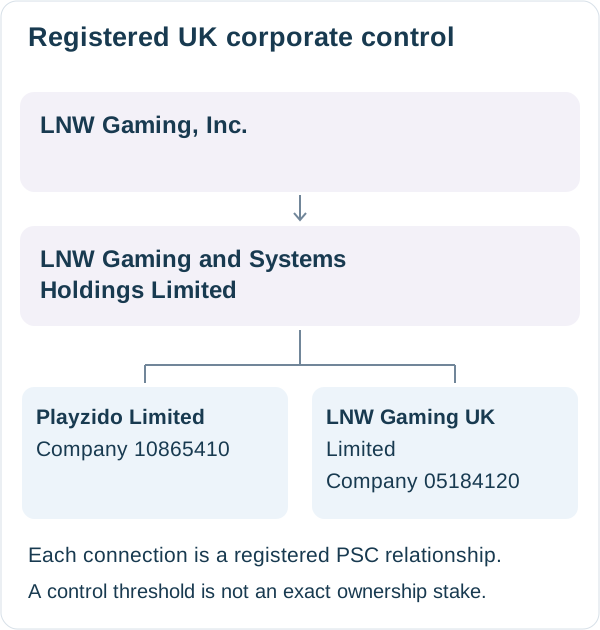
Based on Companies House PSC records. Registered control does not establish the exact direct economic ownership percentage of every entity.
The regulatory picture adds a crucial qualification:
| Legal company / record | Dated finding | Interpretation |
|---|---|---|
| Playzido Limited, Companies House 10865410 | Active company | The legal entity continues to exist |
| Playzido Limited, UKGC account 50878 | Remote Gambling Software and Game Host (Casino) activities Surrendered on 15 June 2026 | Its old UKGC permission should not be described as active |
| LNW Gaming UK Limited, UKGC account 66104 | Remote Gambling Software Active from 11 March 2025; Game Host (Casino) Active from 31 March 2026 | A different licensed legal holder exists within the group |
They do not establish automatic transfer of contracts, intellectual property or permission. See Light & Wonder markets, operators and licences for holder-specific permissions.

Names that do not mean group ownership
The Scientific Games name is a recurring source of confusion. Light & Wonder adopted its new corporate name in 2022, while the former lottery business was sold. The present independent Scientific Games lottery enterprise should not be treated as an L&W subsidiary merely because old materials use the Scientific Games name.
Similarly, OpenBet was sold in September 2022. It is not a current in-house Light & Wonder sportsbook division. Historical product announcements bearing OpenBet branding need dates and entity context; they do not undo the disposal.
MONOPOLY-branded titles illustrate licensed intellectual property. An agreement to use an established franchise in gaming products does not mean L&W owns the underlying MONOPOLY franchise or any independent consumer casino using that word.
WMS and Barcrest are historic names in the group's gaming lineage. Their appearance on older machines or subsidiary records should not be mistaken for evidence of a new standalone operating segment.
Authentic Gaming Limited and Authentic Gaming Malta Limited appear in the FY2025 subsidiary schedule. However, the annual report states that L&W discontinued its own Live Casino operations after a decision made in the first quarter of 2025. A legal company remaining in a filing is not evidence of a continuing active live-casino product. Historical customer relationships with brands such as Sky Vegas or Sky Bingo do not make those operators subsidiaries.
Our Light & Wonder history and acquisitions article separates completed transactions from old commercial arrangements.

What the portfolio tells us
In our view, Light & Wonder's strength lies in the ability to develop and distribute related game concepts through physical gaming, iGaming and social entertainment. Recognisable content can travel across formats, while owned studios and distribution technology broaden commercial reach. The SciPlay business adds another route to audiences, but with a different payment model from regulated real-money gaming.
The limits are just as important. A broad catalogue is not proof of ownership of every game, studio or casino showing that catalogue. A subsidiary schedule is not a live product directory, and an active company is not necessarily an active licence holder. Intellectual-property claims, partner dependencies and changing regulatory status deserve independent attention in our Light & Wonder risks and opportunities analysis.
The useful question is therefore not simply “how many brands does Light & Wonder own?” It is which legal companies and rights support which products, and under what conditions those products reach customers. That distinction makes the group's scale understandable without turning its history into a misleading list of owned casinos.
Sources reviewed: Light & Wonder FY2025 Form 10-K and annual report; corporate announcements; Companies House records; UK Gambling Commission licence summaries; SciPlay terms.