

Litigation statuses below follow the company's Form 10-Q for the quarter ended 30 September 2026 and its results released on 4 November 2026.
Light & Wonder settled its Dragon Train intellectual-property dispute with Aristocrat in January 2026. The harder question is whether recurring gaming revenue can outpace other litigation, borrowing and weakness in social casino games. In the latest quarter, Gaming revenue edged down, SciPlay contracted and iGaming grew. See our Light & Wonder corporate overview for the group's structure.

What changed in Light & Wonder's risk picture in 2026?
The Aristocrat settlement removed uncertainty surrounding those IP proceedings, but not every Dragon Train-related claim. September-quarter disclosures showed sizeable cash generation alongside approximately US$5.0 billion in face-value debt. Meanwhile, iGaming growth did not prevent a modest decline in group revenue.
Debt repayment, acquisitions and share repurchases compete for the same financial resources. I assess these trade-offs together, not through a single earnings or litigation headline.

Which lawsuits still matter after the Aristocrat settlement?
Light & Wonder and Aristocrat announced a settlement on 11 January 2026 concerning the Dragon Train and Jewel of the Dragon disputes. The settlement amount was US$127.5 million, approximately US$128 million when rounded in the company's annual-report presentation. Those particular IP proceedings should therefore not be described as an unresolved Aristocrat lawsuit. A separate Australian shareholder claim about earlier Dragon Train disclosures remains distinct.
The September 2026 Form 10-Q, especially Note 15, identifies several other proceedings. The following statuses are those disclosed by the company, rather than independent findings about who is right.
| Matter | Position in the company's September 2026 disclosure | Why it matters |
|---|---|---|
| AztecGold shareholder claim | Filed in Victoria on 22 April 2026 over representations concerning Dragon Train; Light & Wonder filed its defence on 18 September. | A disclosure-related shareholder case, not a reopening of the settled Aristocrat IP dispute. |
| Casino Queen automatic card-shuffler case | US federal antitrust class action; a 31 March 2026 order resolved some summary-judgement issues and certified a class. Reconsideration was pending; a jury trial was scheduled to begin on 1 November 2027. | Potential damages and litigation expense remain uncertain; allegations are not findings of liability. |
| Mohawk automatic card-shuffler arbitration | Separate class arbitration; further appeal permission was being sought and the evidentiary hearing had been postponed. | Related commercial subject, but a separate procedure with no shared federal trial date. |
| Evolution dispute | Patent-infringement claims were dismissed on 30 March 2026. Trade-secret claims remained subject to ICC arbitration, with a hearing scheduled from 26 July 2027. | Dismissal of patent claims does not mean the entire dispute has ended. |
| SciPlay social casino complaints | De Guzman in California and Herman in Washington, filed in January 2026; the court cases were stayed in favour of arbitration. | Potential consumer-law exposure in US social gaming, not evidence of a UK real-money casino offence. |
The company disputes the allegations. Neither class certification nor an arbitration order establishes liability.
Older exposures include a 2015 SNAI settlement (€25 million upfront; €9.7 million cumulative indemnity payments by September 2026) and the long-running Ecosalud collection dispute. Neither is a new 2026 charge.
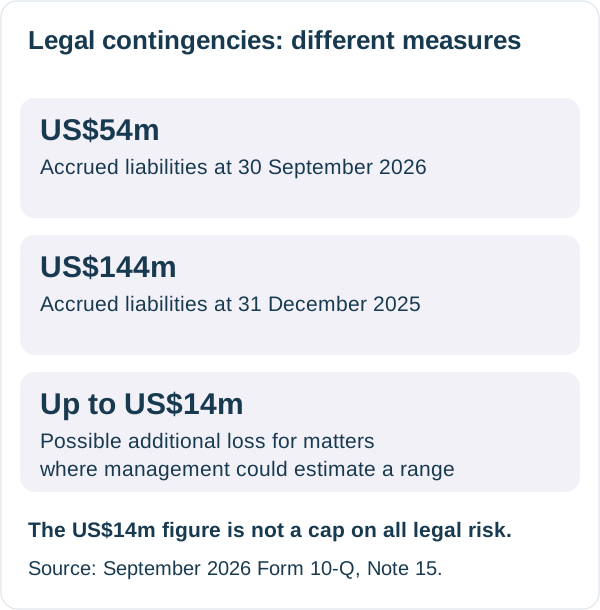
Light & Wonder reported US$54 million of accrued legal contingencies at 30 September 2026, down from US$144 million at the end of 2025. For a subset of matters where management could estimate a range, it identified up to approximately US$14 million of reasonably possible additional losses above related accruals. That US$14 million is not a ceiling on all litigation exposure. The company explicitly excluded matters for which it could not reasonably estimate a possible loss. For me, that limitation is more informative than any superficially precise probability of a legal loss.

Debt, liquidity and room to absorb shocks
At 30 September 2026, the company disclosed approximately US$5,019 million of debt at principal face value and US$4,981 million at balance-sheet carrying value. Those are different measurements of substantially the same borrowing, not two amounts to add together. Cash and cash equivalents were US$139 million. Total available liquidity was approximately US$1,059 million including borrowing capacity under its revolving facility. It would be misleading to call the larger amount cash in the bank.
The company reported covenant compliance at that date. Net debt leverage declined from 3.4 times in June to 3.3 times in September; management's target of below 3.0 times in the first half of 2027 is not a delivered result.
For nine months of 2026, operating cash flow was US$616 million and capex US$247 million. The reported US$545 million of adjusted free cash flow is a separately reconciled non-GAAP measure, not their simple difference or entirely uncommitted cash.
In the third quarter management prioritised deleveraging rather than repurchases under its buyback programme. That decision is defensible while leverage remains elevated, but it exposes a trade-off: less immediate capital return in exchange for greater financial flexibility. Major adverse legal outcomes, weaker customers or heavier investment requirements could still make the pace of debt reduction uneven. Our financial results and debt analysis examines the accounting and cash-flow detail.

Three segments, three different operating exposures
The three businesses moved differently. These are quarterly revenue figures in US$ million from the 4 November 2026 results, not forecasts.
| Business segment | Q3 2025 | Q3 2026 | Year-on-year | Main operating question |
|---|---|---|---|---|
| Gaming | 558 | 554 | −1% | Can premium machines, installed operations and Grover overcome softer systems demand? |
| SciPlay | 197 | 173 | −12% | Can direct-to-consumer gains offset weaker social-casino demand? |
| iGaming | 86 | 97 | +13% | Can content and platform growth withstand operator costs and regulation? |

Consolidated quarterly revenue was US$824 million, down approximately 2% year on year. The group's three reported segments are not interchangeable. Gaming combines equipment and operations; SciPlay sells entertainment and virtual goods in social games; iGaming supplies digital gaming content and technology. Their product economics, customers and exposures differ. Our brands, products and subsidiaries guide explains those distinctions.
Gaming benefits from premium installed machines and Grover's recurring operations, but faces customer capital-budget cycles, competition for floor space and game-launch risk. Our business model and technology analysis explains the economics.
SciPlay illustrates why one encouraging metric cannot rescue the entire story. Direct-to-consumer revenue represented 31% of that segment's quarterly revenue, up from 20% a year earlier. Yet total SciPlay revenue declined by 12%. A shift towards direct customer relationships may improve economics over time, but it is not evidence that consumer demand has already recovered. I would look for sustained stabilisation of overall revenue, not simply a higher DTC percentage.
iGaming's growth reflects content and platform opportunities, but depends on operators' ability to deploy games profitably in regulated markets.

UK gambling duties, regulation and technology constraints
The UK illustrates an indirect risk often missed in simplified descriptions of Light & Wonder. The company is primarily a supplier, not the operator taking a British player's deposit. Nevertheless, higher duties borne by its operator customers can reduce their margins, alter promotional budgets and constrain spending on content or platforms.
In its September-quarter discussion, the company identified UK gaming duties effective from 1 April 2026 and estimated that approximately 15-20% of its iGaming segment revenue was exposed to the relevant UK tax-affected activity. That is a share of iGaming revenue, not 15-20% of total group revenue, and the company's estimate should not be treated as a direct measurement of its own tax bill.
Regulatory scope also belongs to named legal entities. In the UKGC records consulted in November 2026, LNW Gaming UK Limited and Playzido Limited had different licence records and activity histories. One company's permissions cannot be attributed to the entire group. Readers needing the individual records should use our markets, operators and licences analysis.
Shared content across cabinets, online platforms and social channels makes IP controls, cybersecurity and distribution dependencies operational risks. Innovation needs evidence of rights, security and quality controls.

Where can the business still grow?
Three opportunities carry corresponding costs. Premium Gaming installations may improve recurring economics, but require continued R&D, cabinet investment and successful competition for casino floor space.
Second, Grover extends the installed-operations opportunity. Light & Wonder acquired the business in May 2025 for an initial US$850 million, with potential additional contingent consideration of up to US$200 million. The contingent amount is not proof that all of it has been paid. Expansion brings useful recurring exposure, but management must demonstrate integration, returns on invested capital and disciplined deployment. For the deal's history, see Light & Wonder's acquisitions.
Third, proprietary iGaming content can gain distribution in regulated markets, subject to compliance costs and operator economics. SciPlay's DTC strategy offers potential value, but needs revenue stabilisation. All three opportunities must earn their capital.

Three outlook scenarios and the signals to watch
I prefer observable conditions to an invented probability for each outcome. These scenarios concern the business over the next 12-24 months, not a target for the share price.
| Scenario | Conditions that would support it | What would change my assessment |
|---|---|---|
| Base case: progress with friction | Gaming holds its recurring base, iGaming grows, SciPlay remains difficult, and debt declines gradually. | Leverage stops improving or a material lawsuit develops unfavourably. |
| Constructive: operating mix strengthens | SciPlay revenue stabilises, premium Gaming and Grover productivity improve, iGaming retains momentum, and leverage moves sustainably below 3.0 times. | Better margins fail to convert into cash after investment. |
| Adverse: constraints reinforce each other | Customer spending weakens, tax pressure erodes iGaming opportunities, legal costs rise and cash must be diverted from growth. | Covenant headroom, liquidity or content deployment materially deteriorates. |
The Casino Queen trial and Evolution arbitration were scheduled for 2027, but dates can move. Subsequent filings matter more than assuming an assured verdict.
An Australian Securities Exchange listing is now the main public-market reference for Light & Wonder, but valuation and price-chart analysis have their own place in our share price and author outlook. Corporate resilience and whether a security is attractive at a particular price are related, not identical questions.

My assessment as at 11 November 2026
My view is cautiously constructive on the operating franchise, but guarded on the near-term risk balance. The business has genuine scale, recurring gaming economics and evidence of cash generation. Its Q3 performance also shows how quickly that strength can be diluted by SciPlay weakness, operator spending cycles and the demands of a heavily indebted balance sheet. Settling the Aristocrat IP proceedings reduced an important uncertainty; it did not settle every claim or make possible losses fully measurable.
Three developments would make me reconsider: a sustained reversal in SciPlay's overall revenue trend; demonstrable leverage reduction without sacrificing productive investment; and material changes in the remaining litigation or UK customer economics. Until those tests are clearer, I would resist both the argument that Light & Wonder is crippled by its risks and the opposite claim that its risks are now largely behind it.