

Light & Wonder earns money in three distinct ways. Casinos and gaming venues buy equipment or pay for access to it. Licensed online operators contract for games and technology. Players of SciPlay's free-to-play apps buy virtual entertainment items. Those are separate customers, products and accounting models, even when familiar game ideas appear across more than one channel.
The essential distinction is between money flowing through a game and revenue recognised by Light & Wonder. A casino's customer stakes do not automatically belong to its technology supplier. The group's FY2025 Form 10-K identifies Gaming, iGaming and SciPlay as its three reporting segments. Our Light & Wonder company overview explains the corporate setting; here we follow the commercial contracts.

Start with the customer, not the game title
| Business | Who pays | What is supplied | How revenue arises |
|---|---|---|---|
| Gaming | Casino, gaming venue or charitable-gaming organisation | Cabinets, content, casino systems, table equipment and services | Machine sales, participation, rental, maintenance and licensing |
| iGaming | Licensed online gambling operator | Game content, aggregation, hosting and optional operator systems | Contract fees, commonly with variable amounts related to gaming performance |
| SciPlay | Individual social-game player | Virtual coins, chips, cards and entertainment features | In-app or direct purchases recognised as the items are used |
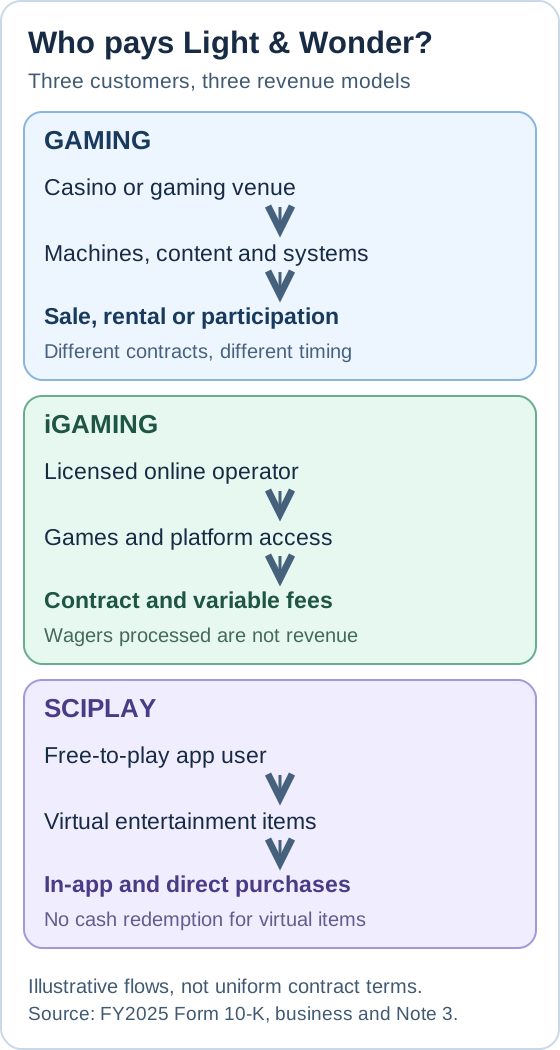
The diagram is deliberately about who owes the supplier money. It is not a map of every transaction on a casino floor or in an app. This distinction matters when comparing recurring service income with one-off product sales.

Gaming: a machine sale is not a participation contract
Light & Wonder's Gaming segment covers far more than slot themes. It sells machines and conversion products, supplies casino-management systems, rents or places proprietary equipment with venues, and provides table-game equipment and services.
A conventional machine sale normally produces revenue when the contracted product is delivered and control transfers. Under a participation arrangement, by contrast, an operator uses Light & Wonder equipment or content while the supplier earns an agreed fee over time. Its FY2025 accounts describe several possible bases: a share of coin-in (amount wagered), a share of net win (wagers less payouts), fixed daily or monthly payments, or combinations. No single percentage applies to all cabinets.
That difference changes the economic exposure. A sale depends on orders and delivery timing; participation depends on the installed equipment remaining productive and on the contract terms. Light & Wonder also bears jackpot-funding obligations under certain wide-area progressive services, with related expenses recorded as a reduction of revenue. Higher player activity is therefore not a guarantee of proportionately higher supplier profit.
In Britain the company's server-based gaming business supplies machines and centrally managed content principally to licensed betting offices, bingo halls and arcades. Contracts can link fees to net win subject to adjustments. The presence of a cabinet does not mean Light & Wonder owns the venue.
The LIGHTWAVE and LIGHTWAVE SOLAR names in the Q3 2026 filing refer to physical Gaming cabinets, not an alternative name for OpenGaming. Casino systems and table products add other payment patterns: software licences, installation, ongoing support, shuffler rentals and proprietary table-game content. Grover's electronic pull-tab participation business also belongs to Gaming. Its acquisition background is covered in our Light & Wonder history.

iGaming: content delivery and player accounts are different services
The Light & Wonder iGaming segment supplies operators rather than taking deposits directly from their British customers. Game studios develop content; hosting and remote gaming servers make it playable; an aggregation network distributes it; and the licensed operator manages the customer-facing casino.
Names that sound interchangeable actually answer different questions:
- Open Gaming System (OGS): the aggregation and distribution network through which participating content reaches operators.
- Remote gaming server (RGS): technology for hosting and delivering game content. Playzido provides one such route; it is not a mandatory stage for every game.
- Open Platform System (OPS): a player-account management and administration product available to operators. It supports reporting and back-office functions where contracted. OPS is not another name for the OGS games catalogue.
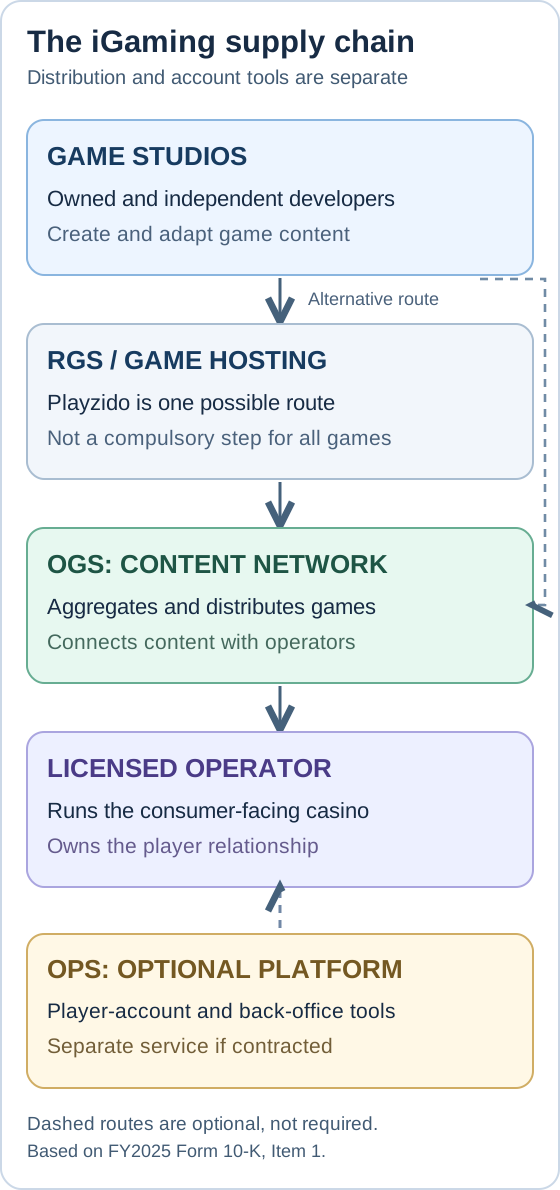
This is a functional map, not a claim that every partner uses the same stack. Some studios supply games through different hosting arrangements. Where OPS is sold, it provides an additional operator technology service rather than turning Light & Wonder into the legal operator of the casino.
The FY2025 Form 10-K says iGaming platform access is typically compensated through variable contractual consideration, such as a proportion of the operator's net gaming revenue. That is a description of the business model, not a published universal royalty rate. The supplier's revenue is determined under its contracts and accounting policies, not by copying the total value of bets passing through OGS.
This creates a different kind of dependence from selling a cabinet. A platform can remain available every day while the amount paid to the supplier fluctuates with an operator's underlying results. Fixed charges, variable fees and the commercial rights of third-party studios can affect the economics differently. Light & Wonder's public accounts do not provide a single price list or royalty percentage covering every operator. Treating the model as one predictable commission on all bets would remove precisely the uncertainty a reader needs to understand.
Nor does distribution establish that a particular game is approved for every British player. The operator's licence, the supplier's permissions, product certification and availability remain separate questions. Those belong in our markets, operators and licences analysis. Ownership of a studio and a platform partnership are different too; see brands and subsidiaries.

SciPlay: spending on virtual items, not withdrawals
SciPlay has a different customer relationship. Its social casino and casual games can be downloaded or started free, but users may buy virtual coins, chips and cards to continue entertainment. The items cannot be redeemed or exchanged for cash. Calling a SciPlay purchase a casino deposit would misdescribe both the product and the accounting.
Under the FY2025 revenue-recognition policy, revenue from these items is recognised as they are consumed in gameplay. SciPlay records this revenue on a gross basis because it controls the game content and functionality, while platform and payment-processing fees appear in cost of services. Thus an app-store deduction is not automatically netted from the reported SciPlay revenue figure.
The route to the customer still matters. Apple, Google, Facebook, Amazon and other platforms facilitate reach and payments. SciPlay's own direct-to-consumer (DTC) purchasing channel creates an alternative route that can change distribution costs and customer relationships, although operating it also brings expenses.
Q3 2026 makes the distinction visible: US$53 million of SciPlay's US$173 million quarterly revenue came through DTC, around 31%. DTC revenue was US$40 million in Q3 2025, yet total SciPlay revenue fell from US$197 million to US$173 million. A higher direct-sales share therefore does not mean that the entire social-gaming business grew. Advertising revenue existed in some games but was described as immaterial in the FY2025 accounts.

Q3 2026: revenue recognised versus activity handled
Light & Wonder's results released on 4 November 2026 cover the three months ended 30 September 2026. The figures below are in US dollars. They are quarterly measures, not annual run rates or balances for November.
| Q3 2026 measure | Amount | How to read it |
|---|---|---|
| Gaming revenue | US$554m | Segment revenue from equipment, participation, systems and table products |
| Gaming operations | US$248m | Includes recurring operations and Grover activity |
| Gaming machine sales | US$199m | Sales of gaming machines and related products |
| Gaming systems | US$55m | Systems products and services |
| Table products | US$52m | Table equipment and related activity |
| iGaming revenue | US$97m | Recognised revenue from content and technology services |
| SciPlay revenue | US$173m | Social and casual games, including US$53m DTC |
| Consolidated revenue | US$824m | Gaming + iGaming + SciPlay |
| OGS wagers processed | US$31.7bn | Betting volume passing through the network; not supplier revenue |
The Gaming sub-lines total US$554 million, and the three reporting segments total US$824 million. iGaming revenue grew 13% year on year; SciPlay contracted 12%; consolidated revenue declined 2%. For the first nine months of 2026, group revenue was US$2.440 billion, but that cumulative figure must not be confused with the single quarter.
There is a further accounting distinction. The Q3 consolidated statement classifies US$599 million as services and US$225 million as products, but that is not a fourth way of dividing the company into segments. Nor is every service fee fixed or assured. Light & Wonder's own recurring-revenue definition includes Gaming operations, ongoing systems maintenance, table rental and services, SciPlay and iGaming. Equipment deliveries have a different profile. The services/products split and the recurring-revenue description answer related but non-identical questions.
The US$31.7 billion passing through Open Gaming System is an operational throughput measure. It is neither Light & Wonder's recognised revenue nor necessarily the sum retained by operators after player payouts. Dividing the entire US$97 million iGaming segment by that volume would invent a supplier take-rate that the accounts do not report. Our Light & Wonder financial results page examines wider margins, cash flow and reporting adjustments.

What cross-platform technology can prove, and what it cannot
A recognisable idea such as Huff N' Puff can be adapted for land-based gaming, online casino content and other formats. Shared development knowledge, game mathematics, art and testing may create efficiencies, while a distribution network can extend the commercial life of content. But versions sold into different environments may need distinct interfaces, commercial rights and regulatory work. One title appearing in several channels is not evidence of identical software or guaranteed returns.
Technology spending also has to earn its keep. Studios, compliance, game servers, customer support and data tools all carry costs. A published SciPlay technology-provider case study describes managed data-workflow orchestration, but it cannot independently establish the group's entire data architecture or quantify its return on investment. Similarly, a broad OGS catalogue does not disclose what every operator pays.
Our view is that the model's strength lies in its different revenue sources and the ability to reuse content expertise across them. Its limitation is that neither recurring fees nor recognisable intellectual property eliminate exposure to operator demand, game performance, platform costs and regulation. Those conditions, rather than the number of products in a catalogue, determine whether technology translates into durable earnings. We consider the downside cases separately in Light & Wonder risks and opportunities.
Research basis: Light & Wonder FY2025 Form 10-K, business description and revenue-recognition note; Q3/9M 2026 Form 10-Q and results released 4 November 2026. The illustrations simplify contract routes and should not be read as universal commercial arrangements.