

You cannot buy shares in NOVOMATIC AG on a public stock exchange. The Austrian gaming technology and operations group is privately held. Ainsworth Game Technology Limited, by contrast, is a separate Australian-listed manufacturer and content supplier trading under ASX:AGI, quoted in Australian dollars (A$). NOVOMATIC is its controlling shareholder, but holding AGI shares does not give an investor a proportional stake in the whole NOVOMATIC group.
The distinction is particularly important after NOVOMATIC's proposed acquisition of all remaining Ainsworth shares failed to complete in February 2026. This analysis uses company filings through 30 September 2026 and market observations dated 12 November 2026, with each ownership and price figure tied to its own date.

Ainsworth (ASX:AGI) share price and chart
| Security fact | Correct interpretation |
|---|---|
| Listed issuer | Ainsworth Game Technology Limited |
| Exchange and ticker | Australian Securities Exchange, ASX:AGI |
| Quote currency | Australian dollars (A$), not pounds or euros |
| NOVOMATIC AG | Private parent-level company; no identified public NOVOMATIC share ticker |
| Quote variants | AGI.AX and AGI.AU are provider conventions for the Australian stock; AINSF is a different US over-the-counter quoting context |
For a dated market reference, one Australian financial-market page displayed A$1.095 at 3.59 pm Sydney time on 12 November 2026, labelled 20 minutes delayed. This was a time-stamped market observation, not a verified exchange close or a live price permanently attached to this article. A subsequent session can move the price substantially, and a broker's executable quote may differ.
The quotation and interactive chart above follow ASX:AGI, in Australian dollars. The provider identifies its observation time, time zone and market status; its D indicator denotes delayed data. Select 1M, 6M, 1Y or All to compare available price history. These prices concern Ainsworth, not shares in NOVOMATIC AG.

NOVOMATIC's stake: majority control, not complete ownership
Ownership changes are easier to understand when each percentage is tied to a filing date. NOVOMATIC's Ainsworth holding has grown, but not every historical percentage describes the register today.
| Evidence date | NOVOMATIC interest | What the figure means |
|---|---|---|
| 28 April 2025 | 52.9% | Holding disclosed when the original buyout plan was announced |
| 31 December 2025 | 65.2% | Year-end figure recorded in the NOVOMATIC group filing |
| 20 March 2026 | 67.39%: 226,956,190 shares | Ainsworth's dated shareholder register in its 2025 annual report |
The March register lists 336,793,929 ordinary shares in total. On that basis, approximately 32.61% were outside NOVOMATIC's disclosed holding on that date. This does not mean that all of the remainder was freely traded: other material shareholders, family interests and nominee holdings also featured in the register. Nor does the table prove that NOVOMATIC still held precisely 67.39% in November.
There is later information about a different shareholder. A substantial-holder notice dated 30 September 2026 disclosed that Kjerulf David Hastings Ainsworth had increased his relevant interest to 35,556,448 shares, or 10.56% of voting power, as at 28 September. That cannot be used to update NOVOMATIC's own percentage by implication.
For minority investors, control matters as much as the percentage. A majority owner influences ordinary shareholder decisions and strategy, while directors retain their duties and listed-company rules still apply. Concentration may reduce trading liquidity. These figures describe the listed subsidiary, not private entities above NOVOMATIC; see who owns and controls NOVOMATIC.

How the proposed Ainsworth buyout ended
Several apparently contradictory headlines (a proposed full takeover, a terminated scheme, an extended offer and a lapsed offer) are accounts of different stages of the same broader attempt.
| Date | Documented development | Status to use now |
|---|---|---|
| 28 April 2025 | Ainsworth announced a scheme under which NOVOMATIC proposed paying A$1 per share for the remaining 47.1% | Proposed, not completed |
| 2025 | The original scheme route did not proceed as initially planned; a separate off-market offer for the remaining shares was pursued | Changing transaction route, not a completed 100% purchase |
| 6 February 2026 | NOVOMATIC's off-market takeover offer closed | Closed / lapsed |
| 11 February 2026 | Ainsworth announced termination of the Transaction Implementation Deed because the scheme had not become effective and the offer had lapsed | Full-buyout transaction terminated |
The 11 February 2026 ASX announcement is the decisive source for the outcome. NOVOMATIC had not acquired the entire minority holding through this transaction. Equally, a failed attempt to buy the remainder did not remove its existing majority control. The historical A$1 transaction consideration is not a standing offer to today's investor or a current valuation anchor.
A different proposal subsequently came from Kjerulf Ainsworth. An April 2026 target statement concerned an A$1.30 per-share proportional offer for 5.5% of each eligible shareholder's holding, not a bid for all outstanding shares by NOVOMATIC. It had a different buyer and a different scope. The price in that document should not be treated as a continuously available exit price after the offer period.
For minority holders, board processes, independent oversight and bidder documentation matter more than speculation about another buyout.

What Ainsworth's first-half 2026 results tell shareholders
Unlike its private majority shareholder, Ainsworth publishes its own financial statements. Its report for the six months ended 30 June 2026 is a useful test of the operating business behind AGI shares. All values below are A$, and the comparisons are with the first half of 2025 unless noted.
| Metric | H1 2025 | H1 2026 | Reading |
|---|---|---|---|
| Revenue | A$152.1m | A$116.484m | Down 23.4%, using rounded prior-year comparison |
| Underlying EBITDA | A$26.9m | A$17.1m | Down 36.4%; management-adjusted, not statutory profit |
| Profit after tax attributable to owners | A$4.9m | A$1.093m | Down around 78% |
| Net operating cash flow | -A$4.687m | +A$8.946m | Strong improvement despite weaker earnings |
| Net debt | A$11.8m at 31 December 2025 | A$8.5m at 30 June 2026 | Lower debt, but comparator is year-end rather than H1 2025 |
The contrast is instructive. Revenue and underlying earnings fell, while operating cash flow improved. The company attributed its better cash result substantially to working-capital movements. That is welcome for liquidity, but it cannot automatically be extrapolated into an enduring earnings recovery. Cash released from receivables or inventory can be different from cash generated by growing demand.
Chart: half-year revenue and underlying EBITDA
The two bar series below compare the same six-month reporting periods. They are not share prices: both are in A$ million. Source: Ainsworth's official H1 2026 interim report; figures rounded for the chart.
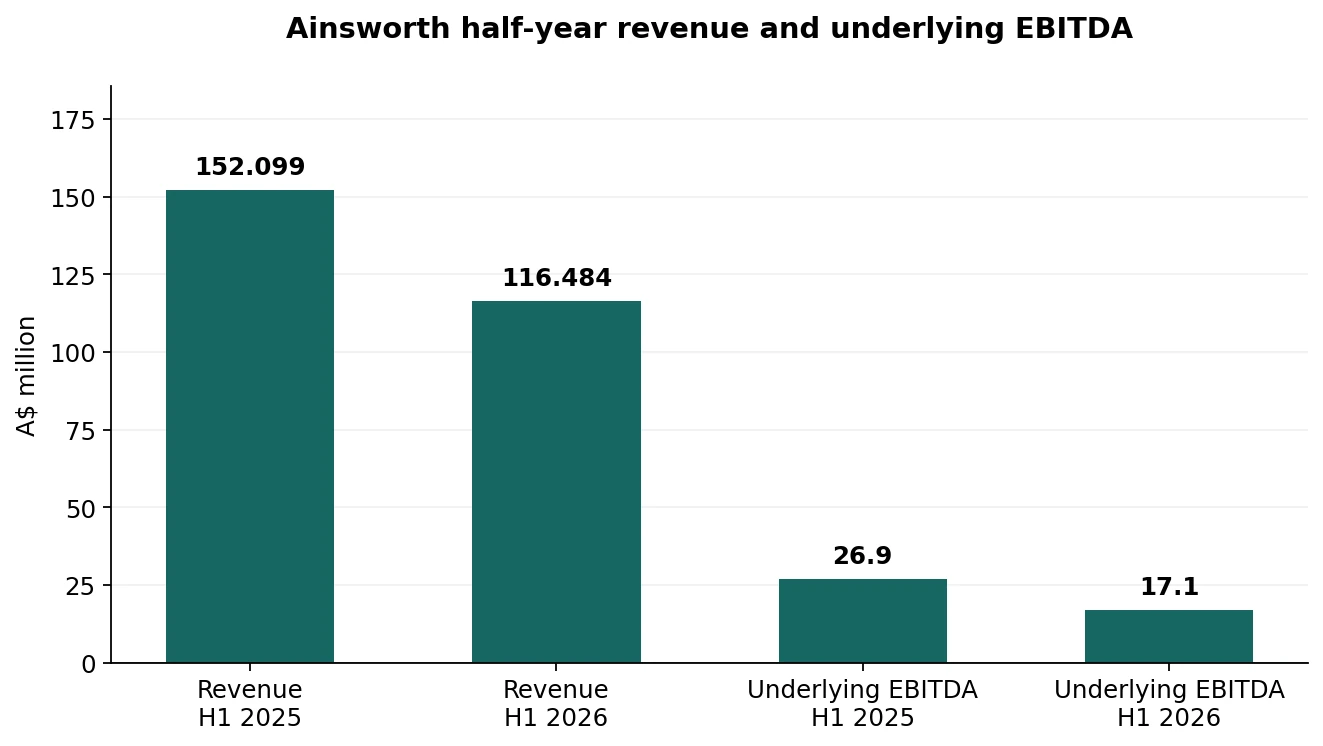
Revenue fell from A$152.099m to A$116.484m; underlying EBITDA fell from approximately A$26.9m to A$17.1m. Different scales mean the chart should be read using the labelled values, not as a comparison of margins.
Chart: operating cash-flow turnaround
This chart uses A$ million and preserves the negative 2025 value. Ainsworth's cash inflow from operating activities improved even as revenue and underlying EBITDA declined.
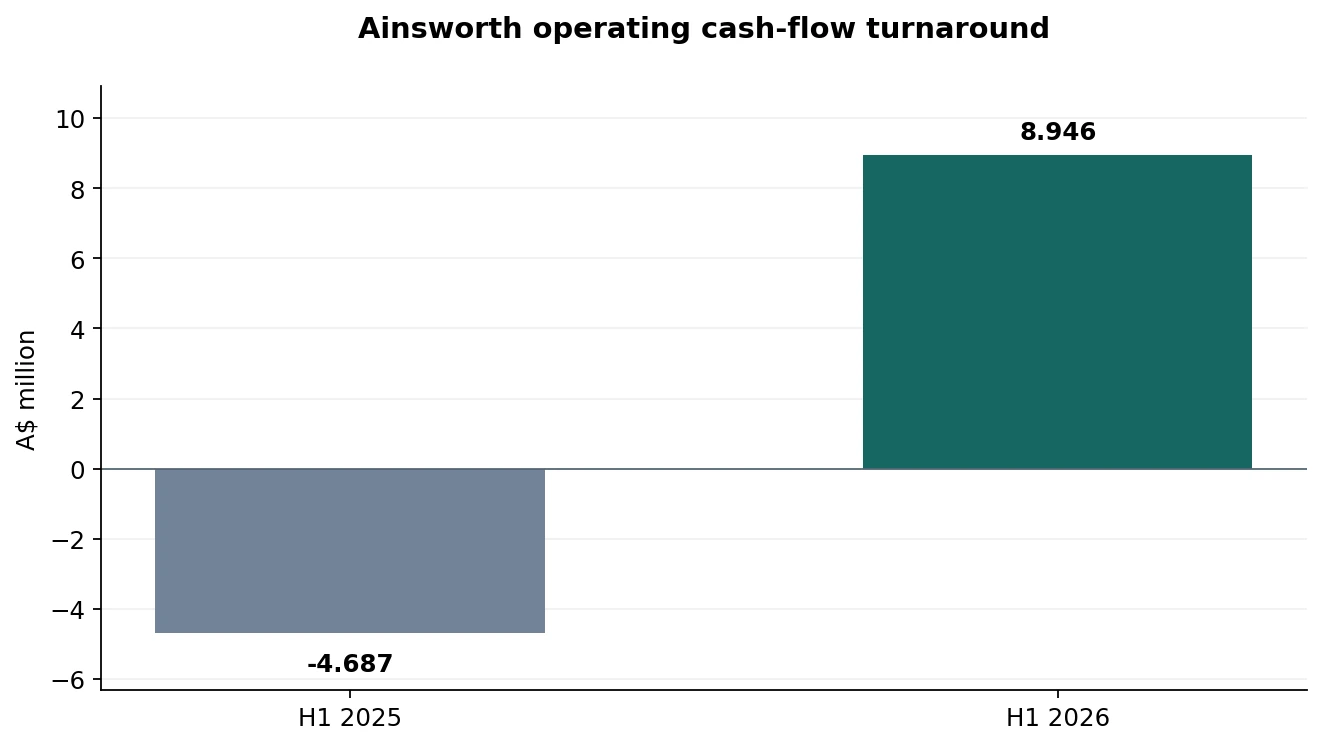
Source: Ainsworth Game Technology, Interim Financial Report for the six months ended 30 June 2026. The two charts are historical accounting comparisons, not a forecast.
The reported underlying EBITDA margin was about 15%, against 18% a year earlier. North American revenue declined from A$83.1m to A$51.9m, accounting for much of the overall fall. H1 2026 segment revenue was approximately A$36.9m in Asia Pacific, A$51.9m in North America, A$25.4m in Latin America and Europe, and A$2.3m online. The group also reported A$18.7m of recurring historical horse-racing connection fees, broadly level with the prior corresponding half.
Recurring service income provides some resilience, but equipment orders and regional demand still matter. Better cash flow and lower debt ease pressure; weaker sales and margins leave a recovery to prove.
These are Ainsworth's Australian-dollar results. They cannot be added to NOVOMATIC's consolidated euro revenue as though Ainsworth sat outside the group accounts. For the parent-level figures and accounting comparability, see NOVOMATIC's consolidated financial results.

What could change the investment case?
The risks affecting Ainsworth shares are not identical to the wider risks of its private parent. I would monitor five concrete channels rather than rely on a generic list of 'market uncertainty'.
North American demand. Sales in this region remained the largest H1 2026 segment, at approximately 45% of segment revenue, but were materially lower than a year earlier. New orders, placements and revenue per installed product will matter more than a single optimistic exhibition announcement.
Earnings quality and working capital. The improvement from negative to positive operating cash flow was material. The next test is whether cash remains positive as inventory, receivables and investment needs normalise, and whether underlying EBITDA begins to recover.
Intellectual-property costs. On 14 August 2026, Ainsworth disclosed a mutual patent-licensing arrangement with Aristocrat in Australia. Ainsworth agreed to pay a total of A$8.5m over three and a half years. The arrangement also provided rights to use certain gameplay features and settled potential historic patent claims. It is a contracted cost and a clearer operating framework, not an acquisition of Aristocrat or a verdict on unrelated trademark disputes.
Governance and the remaining float. A majority holder can bring industrial support and distribution opportunities, but a minority investor does not direct group strategy. The incomplete buyout and separate Kjerulf proposals make independent oversight, related-party disclosures and transaction terms especially relevant. A thinly traded share can move sharply on relatively modest volumes.
Currency and valuation. The shares trade in A$, while some UK readers measure returns in pounds. Foreign-exchange movement can change the sterling outcome even if the Australian share price does not move. A share may also be a good business at an unattractive price, or a difficult business at a price reflecting substantial risk. The case for either conclusion needs a contemporaneous quote and comparable earnings measures, not the April 2025 takeover price.
For the wider legal, licensing and group-level issues, see NOVOMATIC's risks and prospects.

My assessment: base case, upside and downside
As at 12 November 2026, my assessment is cautious rather than decisively positive or negative. Ainsworth's first-half trading deteriorated sharply on revenue and underlying EBITDA, but the company's positive operating cash flow and reduced net debt complicate a purely pessimistic reading. Majority ownership by NOVOMATIC adds strategic context without giving an AGI shareholder direct ownership of the Austrian group's other businesses.
| Six-to-eighteen-month scenario | What would support it | What would challenge it |
|---|---|---|
| Base: uneven recovery | North American sales stop weakening; cash conversion remains positive; margins stabilise | Another marked fall in sales or working-capital reversal |
| Upside: operating improvement | Better machine orders, recurring revenue growth and underlying EBITDA recovery | A higher share price already anticipates most improvement |
| Downside: persistent weakness | Continued regional contraction, margin erosion, rising IP or funding costs | A sustained improvement in orders and cash generation |
These are conditional research scenarios, not probabilities, share-price targets or personal recommendations. They are useful only when tested against subsequent company filings and the market price available at the time of any decision. A valuation assessment would also need the current share count, net debt definition, liquidity and any new material announcements.
The next results must show whether stronger cash conversion can support profitable sales and whether minority-holder safeguards remain robust.

What Ainsworth shares do not buy
Buying AGI means owning shares in Ainsworth Game Technology Limited, subject to its own assets, liabilities, governance and share price. It does not confer an ownership interest directly in every Greentube, Admiral or other NOVOMATIC business. The reverse is also important: parent-group revenue is not the earnings of each AGI share.
Our NOVOMATIC group overview explains the parent business; the NOVOMATIC companies and brands directory sets out the entity boundary. That distinction is the starting point for any meaningful reading of the Ainsworth quote.