

NOVOMATIC's history begins in 1980, when Johann F. Graf established a gaming-machine business in Gumpoldskirchen, Austria. It did not begin as the sprawling international group associated with the name today. The early company made and distributed machines, developed its own technology and soon looked beyond the Austrian market.
There is an important distinction between that starting point and the company's legal history. NOVOMATIC's official timeline identifies NOVO-INVEST CASINO DEVELOPMENT AG as a predecessor of today's NOVOMATIC AG in 1990. Austria's public business register, meanwhile, displays 24 December 1993 as the registration date attached to the present company's record, FN 69548b. Those are different milestones, not competing claims about when Graf began his business.
The more revealing question is how a manufacturer founded in 1980 became both a supplier of gaming technology and an operator with interests across several regulated markets. The answer lies in three overlapping developments: early international expansion, investment in technology and a long series of acquisitions. Some of those deals were completed; others were proposed but never reached the same outcome.

NOVOMATIC history at a glance
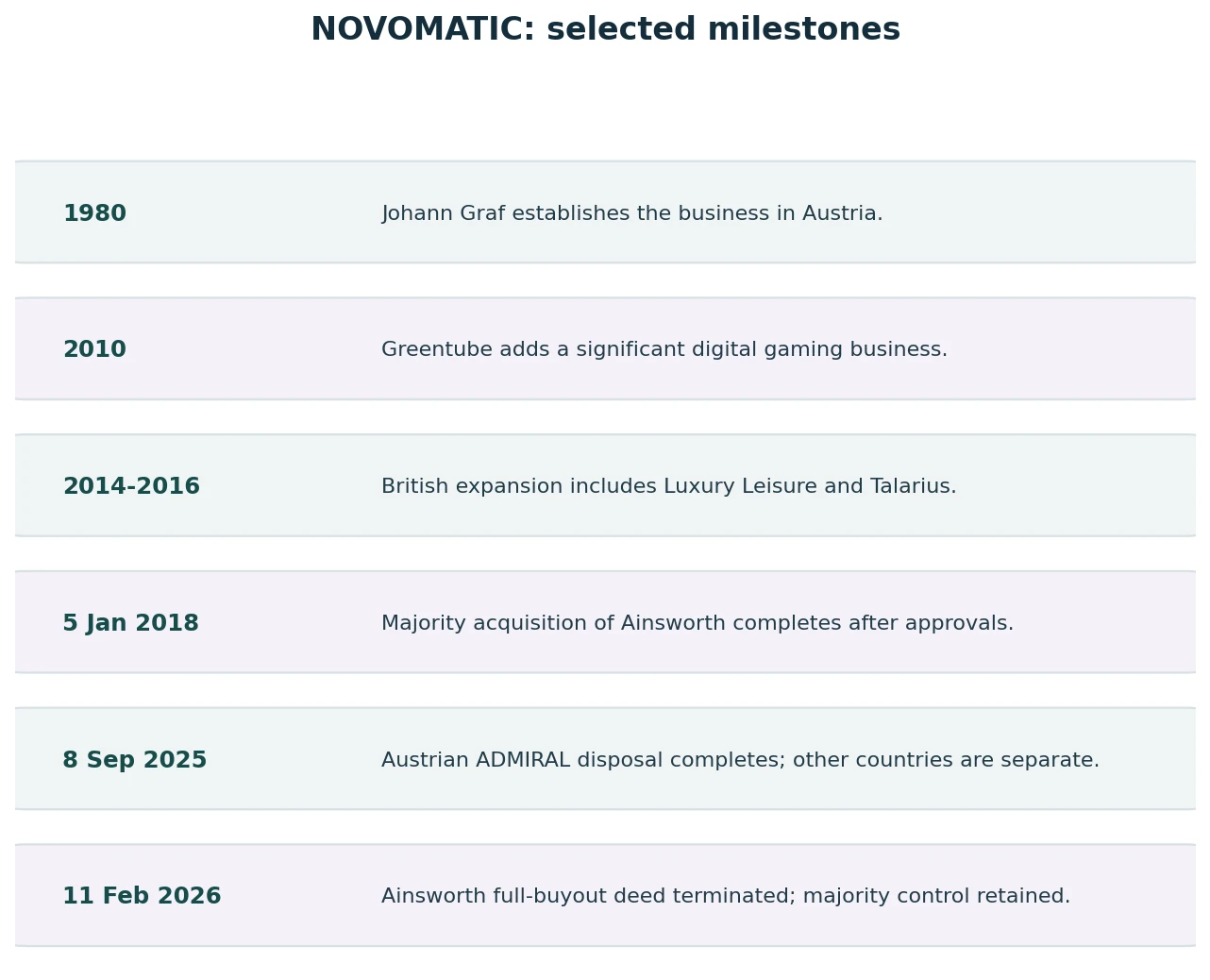
The following timeline selects turning points that materially changed NOVOMATIC's business. It is not a list of every subsidiary, product launch or property opening.
| Year | Event | Why it mattered | Transaction or event status |
|---|---|---|---|
| 1980 | Johann F. Graf founded the original NOVOMATIC machine business and produced early ADMIRAL machines. | Established the manufacturing and distribution base. | Business founded; machines produced. |
| 1981-1989 | Expansion into Western Europe, then South Africa and emerging Central and Eastern European markets. | Reduced dependence on a single home market. | Progressive market expansion. |
| 1990-1997 | A predecessor of NOVOMATIC AG appeared in the corporate timeline; new hardware culminated in the Coolfire platform. | Developed the corporate and technical foundations for larger-scale supply. | Corporate milestone and technology releases. |
| 2004 | Acquisition of UK manufacturer ASTRA Games. | Established an important British manufacturing foothold. | Listed as an acquisition. |
| 2010 | Acquisition of Greentube. | Extended the business into online gaming technology and content. | Acquisition recorded. |
| 2012-2016 | British acquisitions included Bell-Fruit Games, Gamestec, Luxury Leisure and Talarius. | Added equipment, distribution and venue-operation capabilities. | Acquisitions recorded in the group timeline. |
| 5 January 2018 | NOVOMATIC completed the purchase of about 52% of Ainsworth Game Technology. | Added a controlling interest in an Australian listed gaming supplier. | Completed majority-stake acquisition. |
| 2022-2024 | HBG in Italy, Alteatec in Malta and Spati in Italy featured in the acquisition record. | Broadened the portfolio and its capabilities in selected markets. | Acquisitions recorded; individual deal scopes differ. |
| 1 July 2025 | Acquisition of France's Vikings Casinos group was confirmed as completed. | Increased direct casino operating exposure in France. | Completed acquisition. |
| 8 September 2025 | Sale of the Austrian ADMIRAL business to Tipico was completed. | Showed that portfolio management can involve disposals as well as purchases. | Completed sale, Austrian scope. |
| 11 February 2026 | Ainsworth terminated the agreement linked to NOVOMATIC's attempted purchase of the remaining shares. | The proposed full takeover did not turn the 2018 majority holding into 100% ownership. | Proposed full acquisition not completed. |
A signed agreement, regulatory clearance, completed share purchase and subsequent sale are not interchangeable. Treating them all as 'acquisitions' can misrepresent the group's development.

Johann Graf and the business he started in 1980
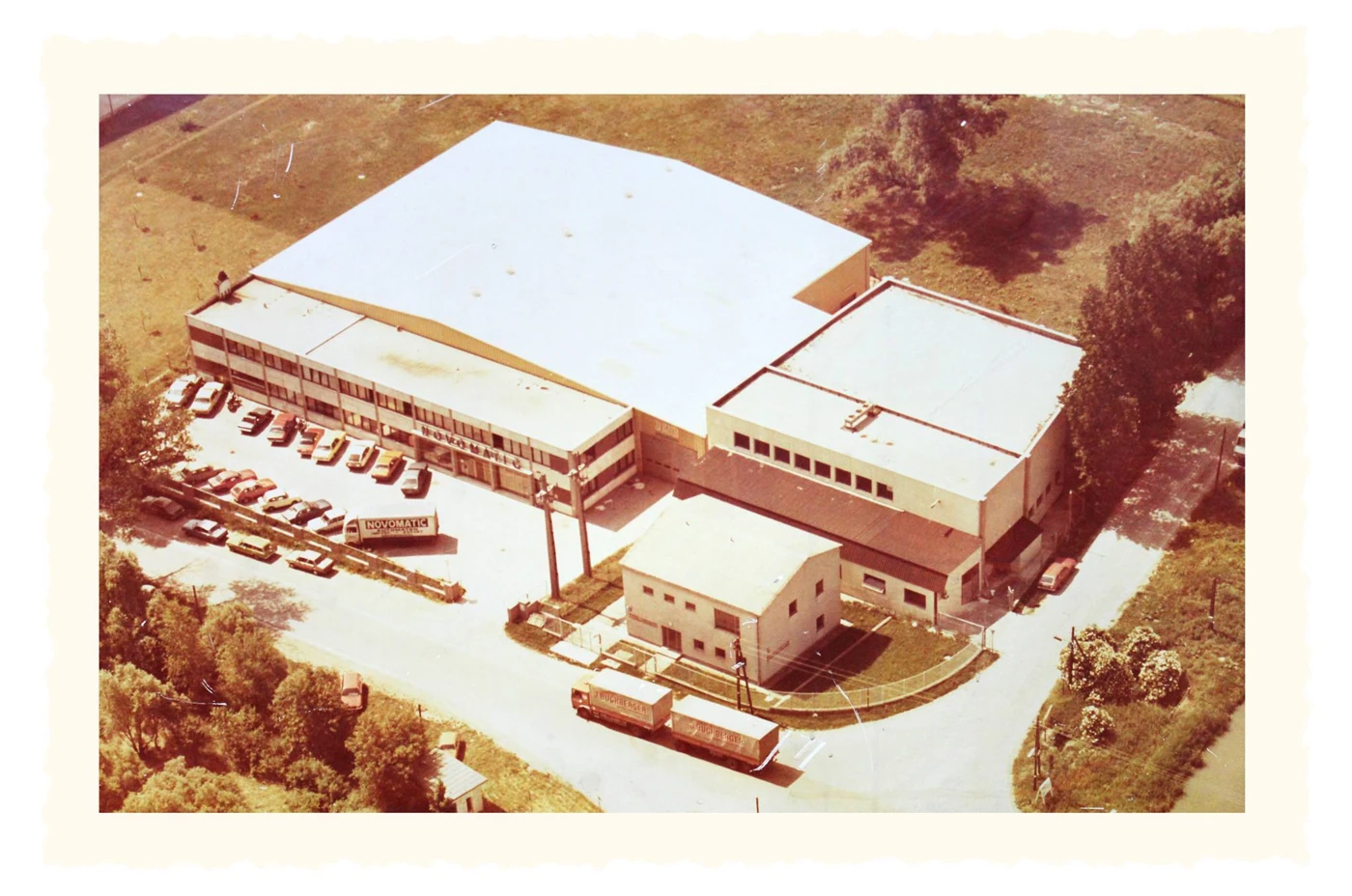
Johann F. Graf is the founder associated with NOVOMATIC's 1980 beginnings. The company's own 40th-anniversary retrospective places the launch in September 1980 in Gumpoldskirchen, a town south of Vienna. It describes an initial team of 12 people and capital of 50,000 Austrian schillings. Those figures illuminate the scale of the starting business; they should not be mistaken for current employment or capital figures.
The first products were gaming machines sold under the ADMIRAL name. In those early years, the business also dealt in equipment from other manufacturers. Its foundations therefore combined manufacturing with distribution, an important point that gets lost when a modern gaming group is described only as a casino owner.
The founder's commercial decision was to seek business abroad unusually early. The official timeline dates expansion into Germany, France, the Netherlands and Switzerland to 1981. Within less than a decade it also records activity in South Africa and the markets opening up around the end of the Cold War. Austria was the place where NOVOMATIC began; it was not intended to be its only market.
Graf's importance to this history is consequently more specific than the familiar image of an entrepreneur building a large fortune. He established a business that could sell equipment across borders, improve the technology inside that equipment and develop relationships with gaming operators. That approach made subsequent acquisitions commercially intelligible: the company could buy access to a market, a manufacturing capability, a distribution network or an operating business rather than relying on a single route to growth.
The limits of those records matter. The official timeline calls the 1980 business NOVOMATIC Automatenhandelsgesellschaft m.b.H., while the anniversary retrospective uses a longer name. It dates the AG predecessor to 1990, and EVI dates the present register entry to 1993. Neither makes 1980 the incorporation date of today's NOVOMATIC AG.
For a current account of the people and entities behind the business, see our NOVOMATIC ownership and management guide. The founder's story and today's corporate control are related subjects, but they are not the same question.

Expansion and technological change, 1981-2009
NOVOMATIC's first major change was geographic. Entering neighbouring European markets shortly after its foundation made the company a cross-border supplier long before online gaming existed. The 1988 move into South Africa showed that this was no longer simply a regional strategy. The collapse of the Iron Curtain in 1989 then opened opportunities in Central and Eastern Europe, markets where equipment, technical support and relationships with local operators would matter alongside brand recognition.
The second change was technological. In 1984, NOVOMATIC developed the MPU 01, a microprocessor-based hardware platform. Later, its 1994 ASIC work and 1997 Coolfire hardware platform formed part of the move towards more sophisticated electronic gaming systems. The technical details have evolved many times since, but the business significance is straightforward: building technology allowed NOVOMATIC to offer more than an imported machine in a cabinet.
This became particularly visible in electronic table gaming and multiplayer systems. The company's historical record links the late 1990s to its TouchBet live-roulette concept, combining centralised game mechanics with multiple electronic player terminals. Such developments gave the manufacturer a way to supply complex equipment and software to an operator, and potentially to service that equipment over its working life.
Proprietary platforms also allowed NOVOMATIC to compete on functionality, integration and maintenance rather than the price of individual machines alone. That helps explain why technology became an enduring part of the business.
The acquisition record also begins to show a deliberate move into established foreign businesses. In 2003, NOVOMATIC acquired Germany's LÖWEN ENTERTAINMENT. In 2004, it acquired ASTRA Games in Britain. For UK readers, ASTRA is a particularly useful historical marker: it indicates that the group did not enter the British market solely through online slots or modern casino brands. It was already building a position in physical gaming equipment.
By 2009, NOVOMATIC had completed a new group headquarters in Gumpoldskirchen. A larger headquarters does not prove the success of every expansion, but it provides a visible endpoint to the transition from the original small enterprise to an international organisation with production, research, sales and operating interests. The next decade would add a new dimension: online gaming.

The acquisitions that changed NOVOMATIC, 2010-2018
Greentube and the online pivot
The 2010 acquisition of Greentube was one of the clearest departures from NOVOMATIC's traditional machine-led origins. Its official timeline states that the group entered the online market through that acquisition. The significance was not simply that an established gambling company acquired another name. It gained a basis for developing and distributing digital gaming content at a time when the distinction between physical and remote gaming was becoming more important.
The resulting model offered different routes to customers: a venue could buy or rent equipment, whereas an online operator might license digital content. Distribution and regulation differ even where development capabilities overlap.
Greentube was therefore an addition to the group's business model, not evidence that every website offering a NOVOMATIC-related game belongs to NOVOMATIC. A supplier relationship is not the same as ownership of the operator. That distinction matters when tracing both the history of the group and its present-day corporate footprint.
Why the British acquisitions matter
The same decade saw acquisitions that expanded NOVOMATIC's position in Britain. Its corporate chronology records Bell-Fruit Games, Gamestec Leisure, Mazoom Interactive Games and RLMS Sales in 2012. It lists Luxury Leisure in 2014, Playnation in 2015 and Talarius in 2016.
These were not identical businesses. Manufacturing and game development, distribution and servicing, and the operation of gaming venues answer different commercial needs. Taken together, they explain why the UK became a more substantial part of the group's international footprint than a single historical purchase of ASTRA Games would suggest.
Those acquisitions could bring manufacturing, distribution, technical servicing and local operating knowledge closer together. They also added separate entities, contracts and regulatory obligations.
That is an analytical interpretation of the sequence, not a claim that every British subsidiary was immediately merged or that all of them have the same licence. Nor should the historical names be used as a substitute for a live company register. Our separate NOVOMATIC companies and brands overview deals with the corporate structure rather than treating an old acquisition list as a current directory.
Ainsworth: agreement versus completion
The Ainsworth transaction provides the clearest example of why dates need checking. NOVOMATIC agreed in 2016 to purchase a majority stake in Australia's Ainsworth Game Technology, a separately listed manufacturer. Regulatory reviews followed. The transaction was completed on 5 January 2018, according to NOVOMATIC's own closing announcement dated 8 January. The completed purchase covered approximately 52% of Ainsworth's issued share capital.
2016 is therefore not the completion date, and the completed transaction conferred control rather than ownership of all Ainsworth shares. The distinction matters because Ainsworth remained separately listed.
Strategically, the 2018 investment expanded NOVOMATIC's exposure to a manufacturer with established activity in Australia and other international markets. It did not make NOVOMATIC AG itself a publicly traded company. Nor did it mean that the Ainsworth story had ended. A further attempt to buy the remaining shares would become a major issue in 2025 and 2026.

The changing portfolio from 2019 to 2026
After the large acquisitions of the 2010s, NOVOMATIC's historical record shows a portfolio that continued to change. New operating businesses, specialist technology companies and disposals all appear alongside ongoing product development. It is misleading to describe this period as uninterrupted expansion in which every announced investment became a completed acquisition.
In 2022, the group expanded in Italy through HBG Gaming. The Italian subsidiary's contemporaneous announcement describes an agreement for an 80% interest and identifies HBG's activities across bingo, gaming-machine networks, betting and online gaming. That detail is more useful than an unsupported claim that NOVOMATIC bought every share of HBG: it shows both the percentage disclosed at the time and the local operating businesses involved.
The official chronology then records the Alteatec Group in Malta in 2023 and Spati S.r.l. in Italy in 2024. These names illustrate different parts of the corporate portfolio, but their appearance on a group timeline does not by itself establish that they were equally large or that they contributed equivalent results. Financial impact belongs in the financial analysis, not in a historical list of transactions.
Two 2025 transactions are more revealing because they pulled the portfolio in different directions.
On 1 July 2025, NOVOMATIC confirmed completion of its acquisition of Vikings Casinos in France following the necessary regulatory approvals. Its announcement described a French operator with more than ten live casinos and around 1,000 gaming terminals at that date. This was an investment in direct casino operations, rather than simply a new software distribution agreement. The group's general online timeline still labels Vikings as a planned acquisition under 2025, but the later transaction-specific completion announcement is the stronger evidence for its outcome.
On 8 September 2025, NOVOMATIC announced that it had completed the sale of ADMIRAL Austria to Tipico. The announcement also said the Austrian business would continue using NOVOMATIC technology. This is a useful illustration of how manufacturer and operator relationships can survive a change in ownership: a group may dispose of an operating company while retaining a commercial role as a supplier.
The geography of that sale must not be lost. It concerned ADMIRAL Austria, not every business using the ADMIRAL brand internationally. Readers should not infer from the Austrian disposal that British ADMIRAL operations or other country-specific companies were automatically sold as part of the same deal.
The second Ainsworth episode is an equally important correction to simple acquisition narratives. In 2025, NOVOMATIC pursued an arrangement to buy the Ainsworth shares it did not already hold. However, the resulting scheme never became effective. An Ainsworth stock-exchange release dated 11 February 2026 records that NOVOMATIC's offer had closed on 6 February and that the transaction implementation agreement was terminated. The attempted full takeover therefore did not complete.
The failed later proposal does not undo the separate 2018 majority investment. A controlling interest and total ownership remain different states.

What this history reveals about the group
What matters most is not the length of NOVOMATIC's acquisition list, but the way different kinds of growth reinforced each other. The first generation of machines created a product business. Early exports turned it into a cross-border supplier. Proprietary electronic platforms made technology a larger part of the offer. Greentube added a digital channel. Acquisitions in Britain and elsewhere brought in businesses that develop, distribute, service or operate gaming products.
That combination also creates complexity. It is possible for NOVOMATIC to be a supplier to one company, an owner of another and a minority or majority shareholder in a third. Historical acquisitions do not erase differences between those relationships. Readers trying to understand the modern group need to distinguish the original business from the current legal parent, the operating brands from the technology suppliers, and an announced deal from one that actually closed.
The mix of the completed Vikings purchase, the Austrian ADMIRAL disposal and the failed full Ainsworth takeover illustrates that distinction. NOVOMATIC's recent history is more complex than simply buying more casinos.
That is also why I would not use the company's anniversary material as proof of future performance. A long history shows the capacity to adapt and transact, but it cannot tell us how profitable a particular acquisition will be, whether a regulatory application will succeed or which asset might be sold next. For the wider corporate picture, our NOVOMATIC group overview provides the broader context.
NOVOMATIC started with Johann F. Graf's business in 1980. Its later history is best understood as a series of shifts in markets, technology and ownership of operating assets, rather than as a single uninterrupted success story. The most reliable chronology names not just the transaction, but what was bought or sold, when it happened and whether it was completed.